
Dissecting ‘Imperial’ Braggadocio
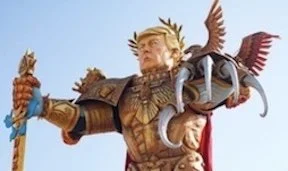
Trump as Warhammer 40,000’s God Emperor
(Sculpture by Fabrizio Galli)
THERE’S AN OLD ADAGE ABOUT THE USE AND ABUSE of power that’s well-known to political observers of the international scene. I can’t remember in which war-torn capital city I may have first heard it, but it goes like this: “Swaggering too easily becomes just flailing.”
The Trump Administration’s swaggering capture and deposing of Venezuela’s now ex-President Nicolás Maduro, achieved by taking full advantage of US Special Forces skill and precision, was a classic case of Big Power braggadocio. And in the wake of this theatrical flourish, the media’s commentariat is struggling to clarify and find some coherence of purpose in the Venezuela action. Purpose, that is, beyond the crudities of the so-named 2025 National Security Strategy, which the Administration published just before the year turned and which carried an underlying deep scorn for diplomacy and alliances.
The tone of adventurism characterizing that document was quickly and sharply illustrated by the Caracas raid. But just in case we retained any uncertainty, White House Deputy Chief of Staff Stephen Miller (below right), Trump’s closest and shrillest mouthpiece, went on CNN to say this:
“You can talk all you want about international niceties and everything else … but we live in a world, in the real world … that is governed by strength, that is governed by force, that is governed by power … We’re a superpower. And under President Trump, we are going to conduct ourselves as a superpower.”
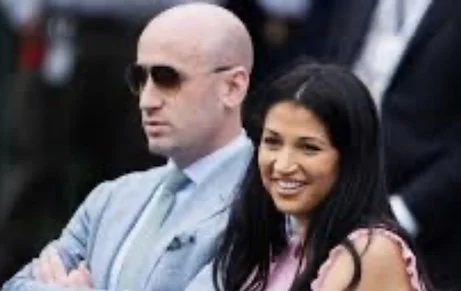
Stephen Miller with wife Katie Miller
There are plenty of indications that Trump wants to show off his superpowers with threats against Colombia, too, plus that hoary old target of American conservatives, Cuba, which has also of course been a close ally of Maduro’s regime. Other countries all across the hemisphere are now supposed to be quivering in fear, including Panama with its vital canal.
It’s all a deliberate harking back to America of the nineteenth century, and that period’s quasi-imperialist Monroe Doctrine, which in his typically juvenile and egotistical way Trump has rechristened as the “Donroe Doctrine.” To my ears, that simply serves to remind us of how one of his ex-wives used to label him – “The Donald.” Or just “Donnie,” as he’s known here in New York to some of his high-rolling, property-speculating associates. To other ears across the Atlantic, to quote words broadcast by the BBC, from a British, formerly very senior NATO commander, the entire Venezuela episode represents a grandiose effort by Trump to become “the Emperor of the Western Hemisphere.”
As the bullying threats proliferate, we’re also seeing a return to a target well outside of our own hemisphere. We see it signaled in a somewhat fantastical way by a perhaps surprising source that we’d do well to monitor carefully. That source is the social media feed of Stephen Miller’s wife Katie Miller. In it she used some crude graphics (below left) to drape a Stars and Stripes flag across the entire map of Denmark’s semi-autonomous Arctic island territory, Greenland. She headlined it with the menacing slogan “SOON!” Trump himself has also hinted (in a muttering kind of fashion) that he’ll turn to Greenland in a couple of months.
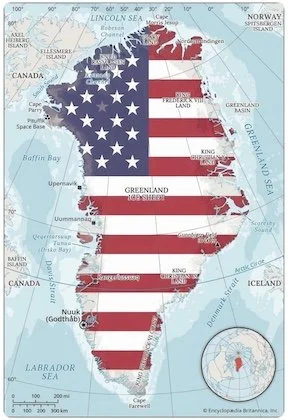
Katie Miller’s version of Greenland
Back last year he was framing an annexation of Greenland as essential, not least by telling the visiting NATO Secretary-General Mark Rutte that “we need [it] for international security.” It’s officially unspoken, but we also have to know that American access to Greenland’s rich mineral resources like lithium and titanium would also come in very handy. Stephen Miller had of course to weigh in himself and he did so with characteristic Big Power dismissiveness. When CNN asked him if military force might be involved, he said: “Nobody's going to fight the United States militarily over the future of Greenland."
Later this week, Secretary of State Marco Rubio tried to walk back his boss’s possible overreach (almost a daily task for him these days) when he told members of Congress that Trump now wants not so much to invade Greenland, as rather to buy it. We have to doubt if that was at all reassuring to committee members, to the Danish government (or to the Greenlanders) or still less, to the whole NATO alliance.
BUT AS FOR VENEZUELA IN THE MEANTIME, Maduro’s Vice President Delcy Rodríguez has been sworn in as Acting President while her former boss faces trial here in New York on a dubious concoction of charges that yoke together drug-trafficking and international terrorism. The federal judicial system has its work cut out with that process – and we’ll see how it goes with Maduro’s next court appearance on March 17th. One thing we know is that Maduro has a good lawyer – the New York defense attorney Barry Pollock, who among other successes, gained a plea deal and release from prison for Julian Assange on his secrets-leaking charges.
Rodríguez’s own standpoint is among many imponderables in the new situation. She’s sounded off to the media at times as a defiant successor to her ex-boss, at other times she has seemed the compliant client of the US – quite the traditional role for Latin American rulers ever since the Monroe Doctrine took its most sinister twentieth century turn, with the CIA manipulating many a nation’s politics throughout the continent.
But the American operation through which Rodriguez came to power at all presents a quintessential Trumpian contradiction. The media have had a busy time digging out all the many recordings of Donald Trump as he campaigned in 2024, solidly against what he kept calling “regime change” - and that two-word phrase now seems to gain an extra snarl from Trump’s mouth every time we re-hear it being broadcast. The question now has to be, how (if you’re a dedicated Trumpist) do you describe what the US has done in Venezuela? The US House Speaker Mike Johnson has here leaped to the fore in defending or explaining the president (his main job, these days, it seems — far eclipsing his supposed job of running a legislative chamber).
How’s this for verbal acrobatics? Johnson said (and I quote verbatim): “This is not regime change. This is demand for a change in behavior by a regime …”
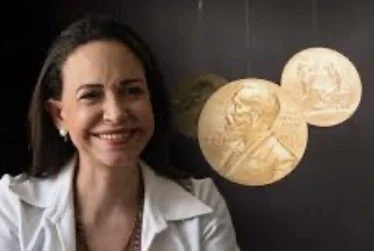
Such contorted language was perhaps only excelled by some pretzel-like twisting from the disturbingly sidelined Nobel Peace Prize Winner, María Corina Machado (right), Venezuela’s persecuted leader of the opposition. She chose Trump’s favorite network Fox News (or to be more accurate, his somewhat less-despised network) to be interviewed, and to obsequiously extend an offer to Trump, for the second time, to share her Nobel with him:
“Because this is the prize of the Venezuelan people, certainly we want to give it to him and share it with him.”
Machado had little choice but to be obsequious -- precisely because she’s been so sidelined. Trump, after all, had previously spoken of her as not suited to the presidency of her country, saying of her that “She doesn’t have the support within, or the respect within the country. She’s a very nice woman, but she doesn’t have the respect.” Good luck, we can wish her, in winning him over.
Trump’s CIA briefings might support the assessment he expressed, but it’s hard not to see considerable subjectivity on the president’s own part. Not least because the Nobel Committee so studiously ignored his desperate efforts to lobby for the prize himself, when they awarded it instead to Machado.
WHICH BRINGS US TO THE KERNEL of Venezuela’s future. It may be clichéd to refer yet again to that long tradition of what were often called “puppet dictators” in Latin America – nasty pieces of work in office, but rulers who were also firmly in America’s pocket, usefully so, according to successive Washington administrations. Those administrations practiced the same cynical game in Asia too – and of course the Cold War meant that the Soviets did the same across their spheres of influence.
It’s all very transactional — almost by definition a Trump characteristic — and certainly in this new Venezuelan iteration it carries the menacing flavor of a protection racket. Let’s just sample some remarks from The Donald (or I can use in this case a totally mafioso-style label, The Don), remarks that he made while talking about the newly-installed leader in Caracas:
‘If she doesn’t do what’s right, she is going to pay a very big price, probably bigger than Maduro.’
And just what might be involved in doing “what’s right?” Again, The Don is totally unsubtle:
“We need total access,” he said, “We need access to the oil.”
And then separately he quantified it. Writing on his social media site, he said he’ll be taking “between 30 and 50 million barrels” of Venezuelan oil. That’s what it means to have a compliant puppet.
The trouble is, of course – and nobody in the White House nor the State Department seems inclined to remember this, even though it was true for the US in Nicaragua, Chile and Brazil and also Vietnam in the far east (and it was just as true for the Russians in Afghanistan) – that puppet leaders regularly prove to be deeply unpopular with their own people … they almost universally become completely mired in corruption … and they can’t help becoming highly unreliable for their puppet-masters.