
Classic Tragedy As Modern Thriller
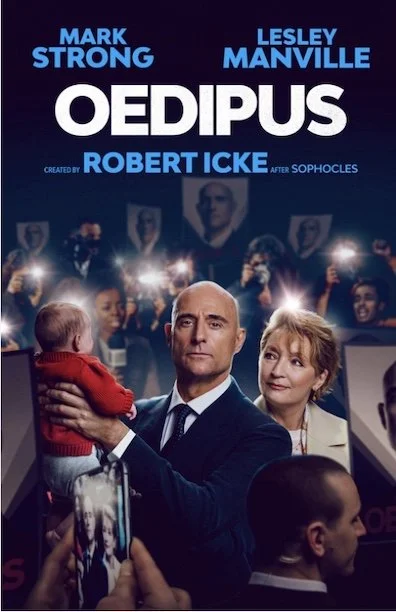
IF LIKE ME YOU PERPETUALLY MONITOR our feverish national and global politics, you might welcome a complete change from the current crazed and formless pandemonium. This week, I turned to a compelling, well-crafted alternative that was originally written two-and-a-half thousand years ago in Ancient Greece.
It’s the well-known and indeed timeless story of Oedipus, by Sophocles of Colonus – though what I saw on New York’s Broadway was a reimagined version for the modern-day stage. The reimaginer was the British writer and director Robert Icke – whose work I’ve had occasion to review once before. The Media Beat, after all, is supposed to cover all media, including the medium of live theatre.
That previous production, nearly nine years ago now, was another reimagining, this time by Icke along with a collaborator, Duncan Macmillan, of the modern classic, George Orwell’s dystopian novel 1984, which I remember describing as a viscerally overwhelming piece of stagecraft.
I’d say the same of Icke’s bang-up-to-date Oedipus, and point out that it also becomes (not unlike 1984) an intense parable about honesty, truth and cover-ups in public life. Mark Strong plays Oedipus, powerfully (and sometimes overpoweringly) as an elected leader in a country that’s (vaguely) British, during the final 2-hour countdown to a result on voting day. He’s a progressive and reformist candidate in a tetchy relationship with his campaign’s Number Two – and there are echoes here of Tony Blair and Gordon Brown.
But the campaigning style recalls Barack Obama – and the omnipresent ‘Oedipus’ poster bears a very distinct resemblance to Obama’s stylish placards. Oedipus is also in another relationship, this one evidently close and loving and enjoyably physical, with his wife, Jocasta (below right). She’s played, with equal strength and brisk determination, by Lesley Manville. Her strength gets to be combined with profound, almost unbearable pathos … toward the end of the play … when the countdown has only minutes still to run, and she reveals an agonizingly terrible, and deeply long-hidden, secret.
Playwrights throughout the ages have taken the Ancient Greek form as something of a template for what tragedy can mean for us in whatever era. Ireland’s George Bernard Shaw made that pointedly clear within the actual spoken text of his play, Saint Joan. A conservative authority figure gives a warning against the apparently unstoppable campaign waged by Joan, the freedom fighter. He says:
The old Greek tragedy is rising among us. It is the chastisement … of hubris.
AND HUBRIS WE DO HAVE IN ABUNDANCE running through Icke’s Oedipus. Even before the action begins onstage, we see television coverage giving us an example of Oedipus as a somewhat improvisational policy-maker, taking decisions on the hoof. For the cameras he announces that, when elected, he will establish an official inquiry into the truth about a long-ago death (a death also long beset with rumors and conspiracy theories) — the death, in fact, of the country’s former leader, Laius.
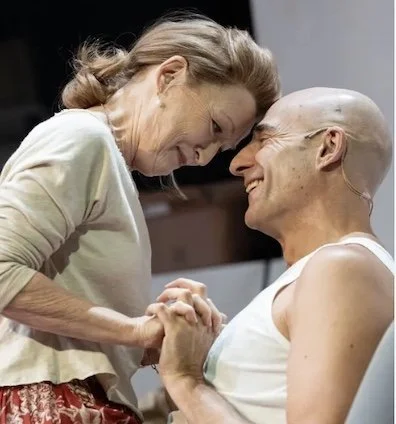
LESLEY MANVILLE and MARK STRONG
Now, Laius also happens — in a way we can’t help but feel is odd, maybe just coincidental, certainly significant somehow — to have been when alive the first husband of Jocasta.
The dialogue crackles with much ironic play on that notion, of Truth. “Everybody lies” someone will say. And from another voice “we are the only ones who know”. Or even – this time from Jocasta herself: “sometimes we just don’t want to know.” But most emphatically, at times thunderously, it is Oedipus who proclaims “I have to know the truth.”
Amid increasing confidence in a successful election result, the evening includes a gathering of the Oedipus family … along with their loyal bodyguard hovering dutifully (played by Bhasker Patel) and the sorely-tried but mostly-loyal Number Two (played by John Carroll Lynch) striving to maintain some cautious prudence. Also present but not always allowed to join the inner sanctum is Oedipus’s mother (though we’ll learn more about that relationship later) who has arrived to deliver her own message of truth, even as her husband lies dying of cancer elsewhere.
This aging maternal character, Merope, is played by Anne Reid – a matter of special charm to me personally, since during my teenage years she was the pretty ingenue in what became the world’s longest-running soap-opera Coronation Street – UK commercial television’s chronicle of working-class life in Northern England. It still continues, now clocking up 66 years, but Ms Reid has gone on to other triumphs like the BBC comedy Last Tango in Halifax, and on the boards in the West End and now on Broadway — a Broadway debut at the age of ninety.

ANNE REID: Broadway debut
Ms REID’s REVELATION AS MEROPE leads to a shocked new understanding for Oedipus of his own origins – they are, let’s say, not what he had believed them to be. But wait, there is more – enough indeed, we all know, for the Oedipus story to have inspired diagnostic labels employed in countless Freudian consulting rooms and in learned psychoanalytical articles.
While in my teen years I may have watched Coronation Street (on a TV set in other families’ homes) but I did also study the Ancient Greeks in high school. And I well remember how much Aristotle, not a dramatist but for me the founding, inspirational drama-critic, admired the elegant, purposeful structure of Sophocles’s Oedipus – it was so complete, he said, because the main character’s enlightenment and his catastrophe are bound up so tightly together. They are essentially simultaneous in fact. And the tragedy is a double tragedy, shared by both Oedipus and Jocasta … though not entirely equally.
Since the Broadway run is now closing, it is no spoiler for me to say that in Icke’s tense and propulsive version it is not Jocasta’s brooch-pin that finally blinds Oedipus, as in the Sophocles original, but a very modern First Lady’s stiletto heel.