
Two Nations: Press Under Fire In Both
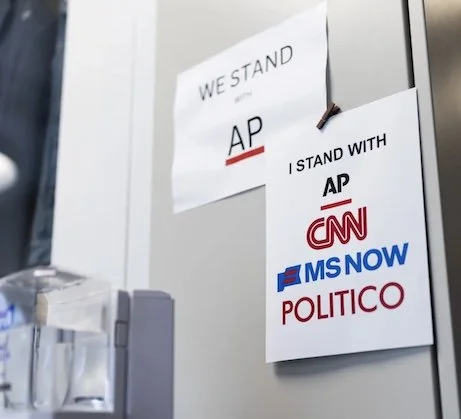
Water-cooler solidarity among White House correspondents
DONALD TRUMP’s ATTEMPTS TO MUZZLE the press continue unabated. His banning of CNN, Politico and MS NOW was struck down by the judicial system, but even so CNN remained credential-less and denied access. Other press organizations, especially including fellow broadcast networks to CNN (even Fox News), expressed solidarity, and declined to visually cover the president’s appearances.
All over the White House, at least in areas where the press corps has generally had access … sheets of paper, informally reeled off from an office printer were pinned to the People’s House walls proclaiming:
We stand with AP, CNN, MS NOW, and Politico.
You’ll remember, of course, that Trump targeted AP, the Associated Press, some time before barring the other three outlets. That case, along with the others, continues to be subject to litigation. AP’s apparently punishable offense, you might remember, was refusing to go along with the President’s renaming of the Gulf of Mexico as the “Gulf of America”.
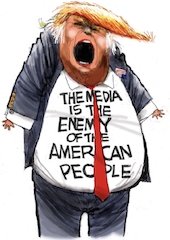
Cartoon by STEVE BENSON, Creators Syndicate
You may wonder – I certainly do – just what was the point for Donald Trump in provoking this whole anti-press fracas in the first place? No US President has ever enjoyed TV attention more than him, and even those who were banned can continue to report verbally on the Administration, although their reports may remain unillustrated with material from TV cameras.
On his social media site he gave his reason for the ban. It was, he wrote “as a result of their constant ‘reporting’ “FAKE NEWS!” Correspondents in the Oval Office asked him: was he upset by any particular coverage recently? No, he told them. “It’s really just cumulative stories over the last two years,” he said. “You get sick of it.”
That line of reasoning, and certainly when cased in those particular petulant words, left his attorneys, who are tasked with trying to legally justify the Administration’s actions, with an obvious problem. They can hardly stand up in court and just say “The President is sick of it, you honor.”
Instead, here’s what was done. The White House press office issued letters to the three newly-banned organizations that accused them of “trafficking in verifiable falsehoods” and “publishing sensitive or classified information.” One individual article cited was a Politico piece from June, that quoted (in familiar political reporter’s style) a “senior administration official” who assessed the odds of a peace deal with Iran as standing at 80% to 85%.
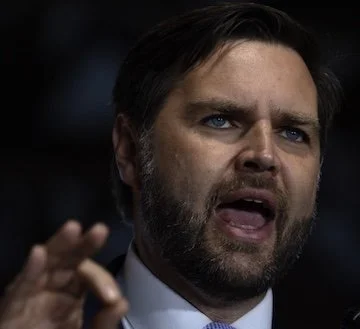
J D VANCE: a.k.a. “senior administration official”
Now, what you need to know (though the Press doesn’t normally break these traditional confidences) is that the unnamed source, the “senior administration official” being so bullish about peace with Iran was in fact Vice President JD Vance. And this was not a leak, as charged; but instead was an entirely authorized briefing. It began, as the taped recording makes clear, with these words from a Press Office functionary: “Thank you for joining this press call. The contents of this call are on background, attributable to a senior administration official.” And then Vance starts talking. It’s worth pointing out that other outlets, besides those being targeted by the White House, also reported that overoptimistic 80% to 85% estimate for peace with Iran. The President’s accusation of unapproved leaking has ended up, you’ll appreciate, looking pretty thin.
We need to remember, too, the wider picture of the President using the courts to hit back more generally at journalism, suing for instance the New York Times and the Wall Street Journal among others. There’s even an international legal contest – as he sues Britain’s BBC for defamation. In this he’s swooping in on the BBC’s own sloppiness in editing a Trump speech in such a way to suggest he was even more directly responsible for inciting 2021’s Capitol riot than he was. The BBC’s producers didn’t need to thus overstate the case … and we all know they deeply regret it, now they’re threatened with possible damages against them of ten billion dollars. They even apologized to Trump for their editing but he’s still pressing the case in a Florida federal court, rather obviously very eager to get his hands on those billions he’s claiming from the overseas public broadcaster.
ATTACKS ON THE PRESS ARE NOTHING NEW FOR OUR PROFESSION. And recently compiled evidence suggests that attacks are getting worse worldwide -- with physical assaults increasing as well as institutional efforts to silence the media. I was this week pondering the matter with a colleague and wondering if nowadays more countries systematically threaten and persecute the press than those which maintain the democratic norm of press freedom. And sure enough a new global report by Reporters Without Borders (RSF – for its name in French Reporters Sans Frontiéres) now bears out this fear.
For the first time in the group’s history its 2026 report says that over half of the world’s countries do now fall into its “difficult” or “very serious” categories for press repression.
Dictatorial regimes of course lead the pack of those who are most repressive, and Eastern Europe and the Middle East remain (as they’ve been for a while) the two most dangerous regions in the world for journalists.
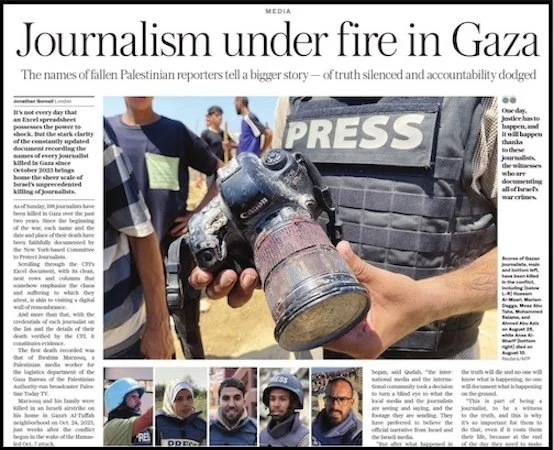
ARAB NEWS on Gaza journalists’ toll
Inevitably, Gaza features prominently – where war raged for two years and still does, even since the ceasefire, more in name than reality, that was supposedly agreed a year ago. Nearly fifteen hundred Palestinians are so far recorded a killed since that “ceasefire,” and perhaps up to a dozen Israelis killed.
The UN Human Rights Office has this year once again condemned what it calls the Israeli military’s pattern of killing journalists in Gaza, which it says is the deadliest location in the world to be a journalist. Overwhelmingly the victims are Palestinian media workers, killed by Israeli forces,
In June this year four journalists died in an attack on Al Ahli Hospital, in Gaza City, plus three more being injured. The Human Rights Office also cites earlier attacks on other hospitals – like the Nasr Medical Complex in Khan Younis where two journalists were killed, and an attack on Al Awda Hospital, where 5 journalists died. Hospitals are - in any war - a place where journalists will inevitably resort, in search of information and figures about casualties … only in this case to become casualties themselves.
There’s dispute about the numbers – of course there is. Israeli authorities frequently label the fatalities as combatants, not journalists; and only this month the Committee to Protect Journalists, who keep the tally, have adjusted their numbers, deciding after further investigation to exclude those dead who might have been Hamas members. But still their overall total sits at 191 Palestinian media workers who’ve been killed since the war began.
It could be said – without necessarily being all that cynical – that the Israeli premiere Benyamin Netanyanu might have plenty of reason to want journalists silenced. The Israeli daily newspaper Haaretz, buttressed by other confirmatory stories from America’s Atlantic magazine and the New York Times, has been dedicatedly revealing some deeply negative information about Bibi, as the Prime Minister is less reverently known. Evidently Bibi was warned some days – maybe 10 or twelve days -- in advance of Hammas’s attack on October 7th 2023 that a deadly incursion was imminent.
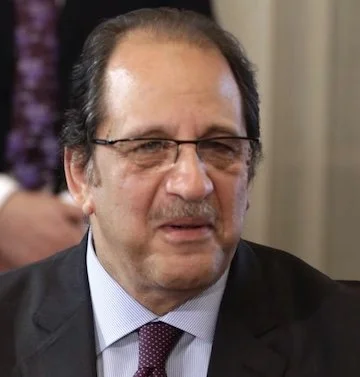
ABBAS KAMEL: Egypt’s top spy warned Israel about Hamas
The warnings came from the United Arab Emirates’ intelligence service, and – apparently repeatedly – from Egypt’s chief spy, too. That top agent, Abbas Kamel (left) even flew to Israel to deliver the message personally on September 26th, and according to Haaretz he made that trip because his service had even earlier sent word to Israel’s security establishment, agency-to-agency – and he was disturbed to see that the Israelis were taking no defensive action in response to his tip-off.
Hardly surprisingly, Haaretz and other Israeli media are now abuzz with editorial pieces carrying headlines like “Netanyahu’s October 7th responsibility is what Israeli’s election must be about.” That election is scheduled for less than a month from now, just a week before America’s mid-terms. Unless, that is, the Prime Minister tries, with some device like declaring a national emergency, to cancel or postpone the national vote. He’s already looking as if he’s in crisis-mode,and has suddenly flown to the UAE trying – those correspondents who shadow him are reporting – to get that country’s president to deny it had warned Israel about the forthcoming catastrophe. All this retrospective finger-pointing has taken place, of course, against the more current background of this week’s dramatic hijack attempt on a Dubai to Israel airliner - which Netanyahu was quick to declare as “under control.”
OUR OWN IMMINENT ELECTIONS MUST RAISE again that question I posed earlier. While it was pretty clear what Netanyanhu is anxious to achieve – an escape from electoral disaster, obviously - what does Trump think he’s up to? What is extra-puzzling, or what is possibly just a sign of delusion, is how much Trump’s positions this year as we approach the mid-terms, utterly fly in the face of US public opinion.
On issue after issue, it is clear. The public wants A.I. to be carefully regulated; Donald Trump wants only the loosest of constraint, with the industry essentially policing itself. “Tremendous self-policing,” he has called it. The public is broadly skeptical about data centers, in many places very actively opposed to them, in considerable cross-party, bipartisan unanimity. But Trump says the only people who oppose such centers are people who want to be, to QUOTE him, "poor and backwards." (I think he means backward, but I could be wrong.)
He also of course continues to pride himself on his import tariffs and is also continuing the war on Iran, with its resultant soaring gas-prices, never welcomed in Middle America. Indeed both of those policies are very distinctly unpopular. As for public concern about price inflation in general, Trump simply turns more contrarian on the subject. He told Reuters newsagency, while speaking about prices, that “if they rise, they rise” and he called the current cost of gas especially QUOTE “a very inexpensive price.”
In sum, none of this rampant Trumpery contributes (if I can cite one of our best White House watchers, Mara Liasson of NPR) to anything like “a coherent strategy to help his party win the midterms.”
And while as a journalist myself I cannot honestly believe the American public cares all that much about some reporters being denied a place in the White House, I cannot see that Trump’s infantile flailings in retaliation against the press will help his party very much, either.