
Scotland to South Africa: Mandela Honored
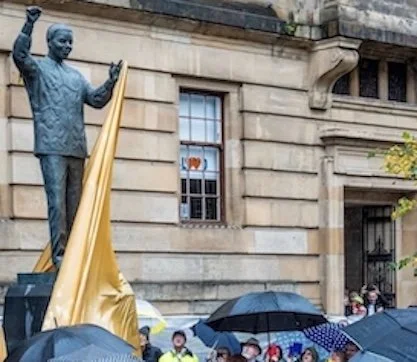
A bronze Mandela’s hand briefly snags the gold unveiling cloth - Glasgow, Oct 2026
HERE’S A HEADS-UP — ADVANCE NOTICE that The Media Beat will soon shift its base to the other side of the Atlantic from its longtime home (in what I’ve always half-jokingly called “The Media Capital of the World,” New York City).
Two weeks from now I’ll start regularly broadcasting and podcasting (and column-writing) from Dublin, Ireland, our new main base. Ahead of that, today, I want to look to another major European city, Glasgow in Scotland, just a short distance across a northern stretch of the Irish Sea. Attention must be paid to Glasgow, because of a brand-new and notable change in the city’s landscape – a monumental statue unveiled last week to Nelson Mandela.
There’s a strong tie between Scotland and the fight to free South Africa from its long-lasting oppression under White supremacist rule – the vicious policy of apartheid. At the statue’s unveiling, a speech was made by South Africa’s current ambassador Kingsley Mamabolo (and technically, for historical reasons his position is known as his country’s High Commissioner to Britain). He said it was “a profound honor and deeply moving privilege” to be present. He went on to express gratitude nation to nation:
“For decades,” he said, “Scotland stood as the very epitome of the British people’s solidarity and fierce struggle against the brutal apartheid system ... Cast in bronze, this tribute stands as a bridge between Glasgow solidarity and the generational sacrifices that have built our freedom… Standing on this very ground, we are reminded of the bold, creative, and defiant steps taken by this great city.”
Glasgow has indeed had a long tradition of progressive politics, stretching back as far as and beyond 1787, when 6,000 cotton weavers and other workers bravely protested against a massive wage cut, that had been driven by cheap foreign imports. Infamously, the British Army turned its guns on the demonstrators, killing six in the Glasgow crowd.
Mandela’s life-size likeness joins that of Mary Barbour in the city’s Govan district, home to its renowned shipbuilding yards. Barbour was the trail-blazing early 20th century organizer of rent strikes, who as well as decent housing, championed gender equality and social welfare, notably health provision for children. And on the city’s major thoroughfare, the Broomielaw, the La Pasionaria memorial commemorates the thousands of Scottish volunteers who gave their lives fighting against 1930s fascism in the Spanish Civil War. In later times, many Scots came to see South Africa’s white rulers as another form of fascism.
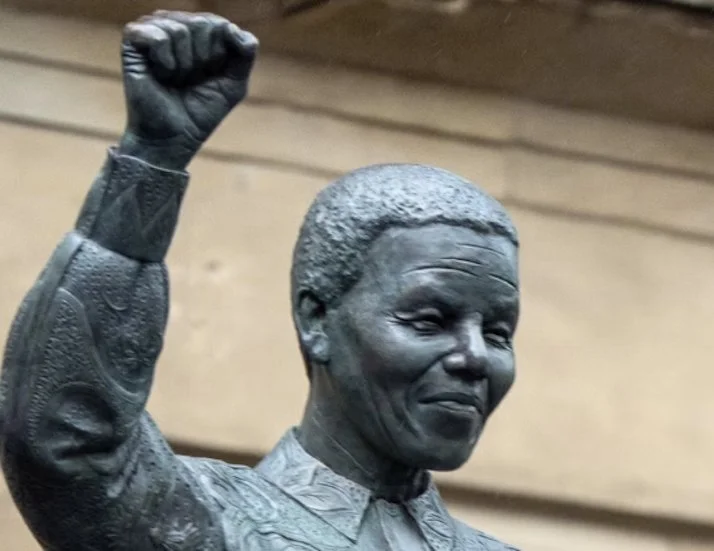
The Mandela smile: “unabashed fun”
The new statue in fact refers back to a specific day, exactly 33 years ago when Mandela himself visited Glasgow. While he had been incarcerated in an apartheid prison for twenty-seven years nine British cities granted him, in his absence, the freedom of the city; but Glasgow had been the very first, back in 1981. And so in 1993 he traveled there to accept the honor in person. As well as his own rousing speech of thanks, there was also music - and singing from South Africa’s own hugely popular recording artist, Marah Louw.
The future president of a free South Africa then did something that he was becoming rather noted for doing. He danced … in his slow-ish, careful 75-year-old’s sashay. To quote the next morning’s edition of Glasgow’s own newspaper, The Herald:
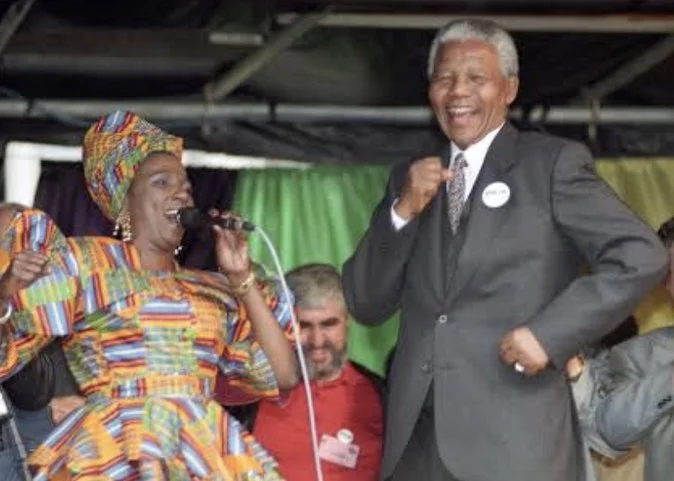
Mara Louw & her future President - Oct 1993
“It was a wonderful display of genuine humanity and unabashed fun, qualities which are all too rare in the austere ranks of the world’s great statesmen.”
A left-wing press in Glasgow afterwards published, to considerable commercial success, a slim, colorfully illustrated book for children that used the occasion to explain the history of South Africa’s long struggle. It’s called simply “When Mandela Danced in the Square. And oh, incidentally — and unsurprisingly too — George Square as it then was, has since been renamed Nelson Mandela Place.
MY OWN MEMORIES OF MANDELA are such that I can only wish they were greater. For they amount in essence to only one, brief encounter.
In 1994, just seven months after that Glasgow event, I was in Johannesburg at a press conference for the very last day of South Africa’s electoral campaign stumping for its first-ever free, multi-racial elections.
Mandela, as the African National Congress’s candidate for president, was addressing all of us journalists and as the Q & A ended, he would be hustled away. He was going to sit for three successive, one-on-one interviews with — who else? — the major US network news-anchors, who in those days comprised the triumvirate of ABC’s Peter Jennings, NBC’s Tom Brokaw and CBS’s Dan Rather. The ANC party’s savvy media-staff knew what mattered most. Their target audience was Wall Street. At this vital, sensitive moment their task was to keep the country’s position steady in the world’s financial markets as it went through its unprecedented political upheaval.
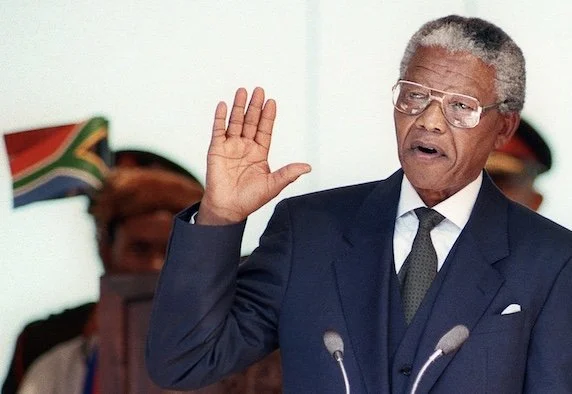
Swearing-in Mandela - Pretoria, May 1994
So the American TV networks had to take precedence. The reassuring voice of Mandela, the carefully spoken sage, was to be channeled through New York’s most important broadcasters. All other reporters, including me, were boxed out.
We were all in Jo’burg’s Carlton Hotel, which was a second home of mine, always staying there ever since I began covering Southern Africa in the early 1970s. The previous night
I had paced the back corridors with the help of hotel staff-members I knew of old.
We figured out by which route Mandela would be taken to the room where the networks’ cameras were set up. To get there privately and unseen, he’d have to go, it was clear, through the hotel kitchen’s storage area,
So, among towering shelves of industrial-sized tomato-cans and flour-sacks my crew and I waited to accost him — or, in our newshounds’ term of art, to “doorstep” him.
My assignment was to cover the elections for the United Nations television service, so my first words came easy.
“For the United Nations, Sir, can I ask: how big a turn-out do you expect in tomorrow’s election?”
“Ah, yes, the United Nations,” Mandela said, and the guard on his left-side started to angle a shoulder between me and his boss. But he was motioned aside by his boss’s almost imperceptible, patrician hand-gesture.
“The United Nations,” Mandela went on, “deserve our great gratitude for the extraordinary assistance they have given our country during the preparations for this important day.” Such deliberation in his delivery. Maybe he talks this way all the time, I thought, not only in speeches. I found myself absurdly flummoxed, to an extent that I’ve never experienced in the company of any other public figure, and I lost my train of thought. I could only think: “I’m here with Mandela, in the kitchen!”
On some kind of autopilot, I managed to splutter out a few more questions, in addition to the likely percentage turnout. There were obvious concerns about security to raise, and the possible effect of some late entrants as candidates in the race, plus maybe a few other, organizational matters.
I probably ended up taking six minutes of his time. And it was naturally he who brought the exchange to a polite close. And as we shook hands, I uttered possibly the most anodyne and, if I’d thought about it, wholly superfluous, needless phrase I could possibly have expressed: “Good luck for tomorrow, Sir.”
He won, of course, by a massive landslide.
Video from Scottish ‘Daily Record’