
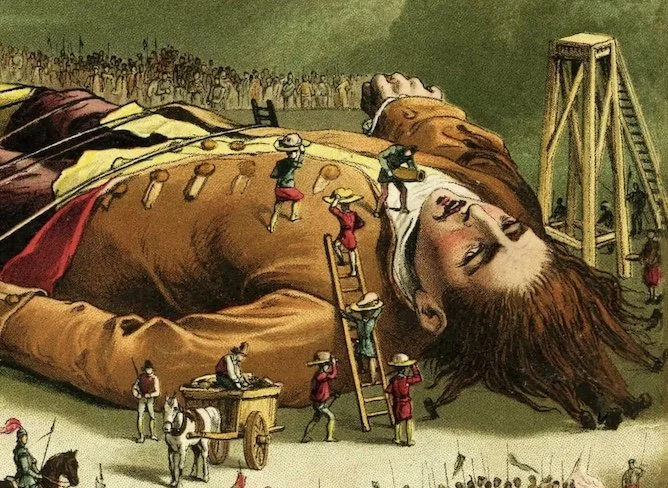
Gulliver awakens tied-up in Lilliput (a Victorian edition’s illustration)
THIS COMING WEEK SEES THE THREE-HUNDRETH anniversary of a world-famous literary masterpiece. It will be three centuries on October 28 since Gulliver’s Travels was first published. A monumental treasure of English Literature, it is often said – though I prefer to say “literature in English,” given the actual truth of the matter. Its author, Jonathan Swift, like so many magnificent writers of so-called English Literature, was in fact Irish – born and bred in Dublin’s Fair City.
The book, though, was published in London, and instantly proved to be an explosive political satire. Perhaps wisely it was published under the eponymous pseudonym of “Lemuel Gulliver,” Swift’s fictional surgeon (and also sea-captain) who serves in the book as both narrator and protagonist.
New editions were run off within three weeks and again in December that year, 1726. John Gay, Swift’s English contemporary and himself no slouch in the satire business, as author of The Beggar’s Opera for instance, wrote soon after Gulliver’s publication: “From the highest to the lowest it is universally read, from the Cabinet-council to the Nursery.”
Another close friend, the poet Alexander Pope, already famous for among other things his long satirical verse “The Rape of the Lock” was even more energetic as a publicist for Swift. Word spread fast overseas, and almost immediately the Travels were published in French, in Dutch, and thereafter many, many other languages.
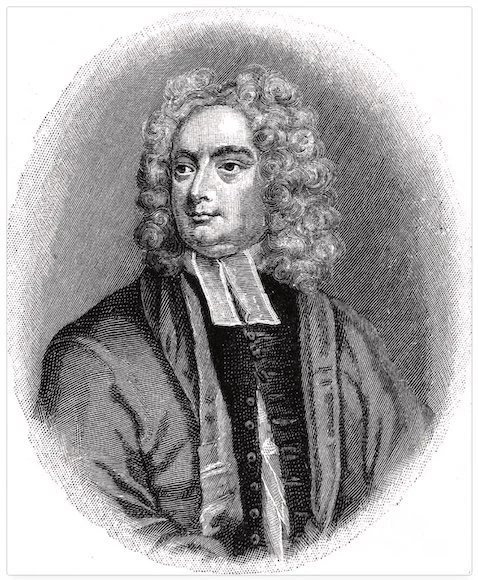
The Very Reverend Jonathan Swift, D.D.
And just what did it satirize? – well, lots of things of course, but perhaps most fundamentally its targets were its own age of European exploration (and increasingly of conquest and colonization) all underway so unstoppably by the early eighteenth century.
At one point, Lemuel Gulliver the explorer tells us something straightfacedly: while Swift’s undercurrent is clearly ironic, bitterly sarcastic indeed
If a Prince send Forces into a Nation, where the People are poor and ignorant, he may lawfully put half of them to Death, and make Slaves of the rest, in order to civilize and reduce them from their barbarous Way of Living.
Divisions within societies get satirized in the book, too.
In the realm called “Lilliput,” Gulliver is famously a giant to a race of tiny people. But among the Lilliputians there is contention between two factions: the Big-Endians vs. Little-Endians. A bloody civil war is fought over whether a boiled egg should be cracked at the big end or at the little end. Swift of course had in mind the centuries of conflict between Catholics and Protestants, that included some punitive English legislation which barred Catholics from holding any public office. Living in one of Britain’s earliest colonies, Ireland, Swift himself just happened to be Protestant.
In the realm of “Brobdingnag,” imperialism is even more fully skewered, when suddenly Gulliver is among giants – and so by comparison is a tiny fellow himself. “Inconsiderable” he is described as being. To a giant, of course, he is just not worth considering.
In a further realm, that of the Yahoos and the Houyhnhnms, Swift dismantles the self-righteous self-image of colonizers. He demonstrates how greed, violence, and lust for domination all expose imperialism as, if anything, more beastly, more inhuman than the allegedly “savage” populations it is conquering.
The Irish Times columnist Fintan O’Toole, who also writes for the New York Review of Books, has in a recent essay pointed out some very clear relevancies in Gulliver’s Travels for our modern world, perhaps especially for America’s place in the world. He wrote drily: “One belongs either to the greatest nation on earth, or to the wretched of the earth. Greatness thus depends on there being a wretched of the earth.”
Swift indeed had his character Gulliver revealed as neurotically hovering between his greatness and littleness. He dwelt on the “Mortification” and Gulliver’s “terrible Agitation of Mind” over being one moment regarded as “the greatest Prodigy that ever appeared in the World,” when he was a giant in Lilliput, and then a contemptible little creature with little status when in the land of giants.
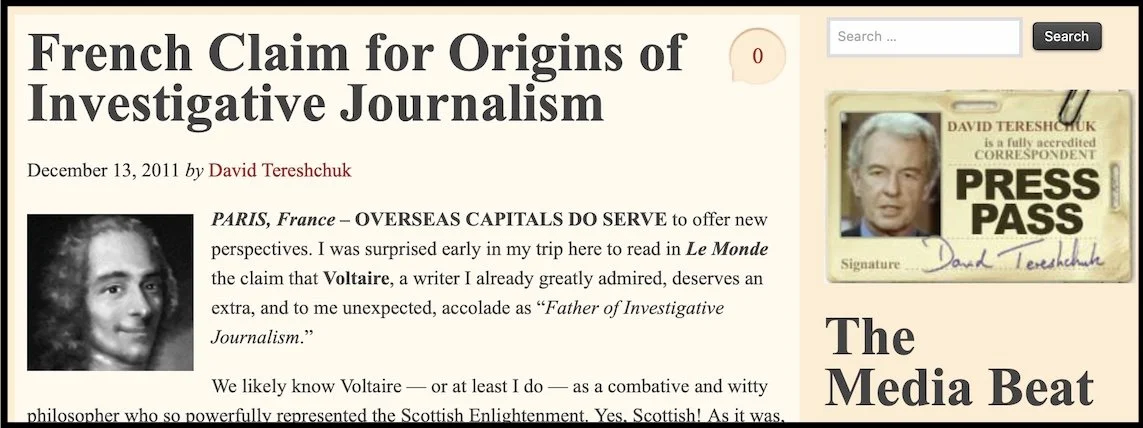
Voltaire in The Media Beat, 2011
FOLLOWERS OF THE MEDIA BEAT WILL NOT be surprised that I need to now bring in Voltaire, France’s leading satirical genius who was perhaps predictably very friendly with Swift, and very clearly shared a lot of the Irishman’s concerns.
My column and podcasts have previously poured praise on not just Voltaire’s comic masterpieces like Candide, but also on his less well-known, but incisive career as an investigative journalist – often exposing injustices inflicted by the so-called great, upon what they would regard as lesser folk.
But of greatest relevance here is Voltaire’s rather similar venture to Gulliver’s Travels, published considerably later than Swift’s opus, and unmistakably influenced by it. It’s similar but it contrives to be both less ambitious and more ambitious than Swift. Less in that the work, titled Micromégas is a very pointed short-story at just 38 pages, compared with the Irishman’s baggy, discursive novel of nearly three hundred pages that included many fanciful illustrations and even some persuasive-looking maps.
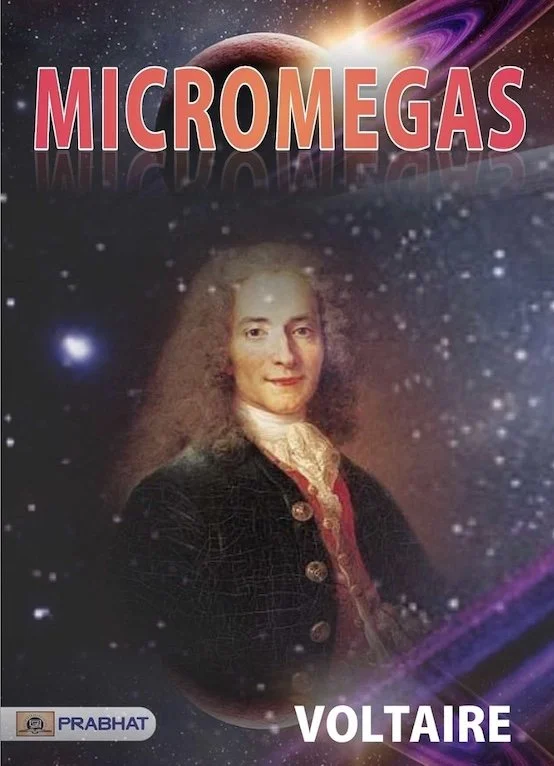
Modern-style science-fiction, antique author
Voltaire’s story is more ambitious in that while Gulliver’s travels are limited to the wilder regions of this earth, Micromégas takes us on an interplanetary journey. It could qualify as It could well qualify as one of the world’s earliest examples of science-fiction.
Voltaire’s hero is that titular Micromégas – and his name translates simply to “Little-Large”, reflecting Voltaire’s interest (like Swift’s) in the politics of size, or greatness versus smallness. Micromégas himself stands 120,000 feet tall (that’s about 23 miles high) being a citizen of one of the planets circling Sirius, where everyone is around that height. And as a curious scientist he makes a study of the planet’s insects, which are too small for the naked eye to see, indeed too small even for his planet’s existing microscopes – the little creatures are after all only a hundred feet high. Such studies are judged by the authorities to be a heresy and Micromégas is sent into exile. (We should remember this was written in the aftermath of Galileo’s and Newton’s authority-challenging discoveries.)
As an exile, our hero is thus sent traveling through the universe and experiencing many adventures that Voltaire narrates pithily. Not least is Micromégas’ arrival on a decidedly diminutive Planet Earth, along with a companion he’s befriended along the way from Saturn (who by the way, compared to him is described as “a dwarf”, standing only six-thousand-feet high). Together they can only see the human beings on Earth with the aid of a presumably gigantic magnifying-glass. Much of the story’s humor, and its many sardonic insights, are prompted by such differences in size – but (or is it and?) they are all set against a backdrop of Voltaire’s insistent egalitarianism … and what, at more than one point, is celebrated as the “equality of the mind at all scales.”
Swift would doubtless have approved, but he died well before Micromégas went into print. The two men certainly admired each other’s work and corresponded corresponded with each other. And it’s possible that they actually met shortly after Gulliver was published, at a country house where they were both guests. It is known for sure that Voltaire wrote two generous letters of introduction for Swift to carry with him on a planned visit to France.
THREE HUNDRED YEARS NOW AFTER SWIFT another fellow-Irishman similarly egalitarian in outlook is Philip Pettit, from the western County of Galway, who is a professor at Princeton University, its Professor of Human Values, indeed. And in his masterful book on Republicanism (real republicanism, I will say) he posited the so-called “eye-ball test.” He wrote, now famously, that a good test of a genuine republic is when we can all “look others in the eye without reason for fear or deference.”
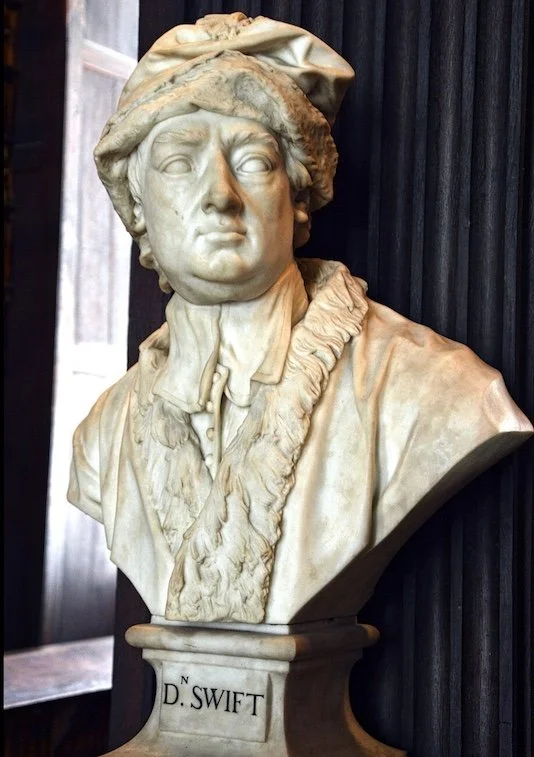
Trinity’s bust of Doctor Swift
We might think that the all-too-long overthrow of slavery and the dismantling of the European empires – those execrable examples of the imposition of so-called greatness upon the supposedly “inconsiderable” - have helped the world to greatly appreciate seeing each other squarely eye-to-eye, but of course we cannot be too sure of that.
The much more recent raucous call, for instance, that America should somehow be “Great” again (which is voiced so inaptly in a country which itself began as a subjugated colony) is the kind of folly that Swift was so vigorously and convincingly attacking.
Most of Gulliver’s Travels was written in Dublin – in fact in Marsh’s Library, which sits in the close of St Patrick’s Cathedral, where Swift was the Dean. Dublin is capital now of course of a country which took its time (a lot longer than Americans) to achieve freedom from a country that called and still calls itself “Great” – Great Britain. Dublin displays its full share of memorials to the liberated country’s heroes, including three busts representing Swift – one in his own Cathedral, one in Trinity College, another in the no-longer-colonial Dublin Castle.
Fintan O’Toole pointed out while considering Swift’s juxtapositions between the-great-and-the-small, that his city has also among its heroes erected a statue to honor the early-twentieth-century Irish labor leader, James Larkin, who also co-founded the revolutionary Irish Citizen Army. His likeness in bronze stands on the city’s central, main street, and below, on his pedestal of County Wicklow granite, is carved (in Irish, English and French) an often-repeated observation of his: “The great appear great because we are on our knees. Let us rise.”