
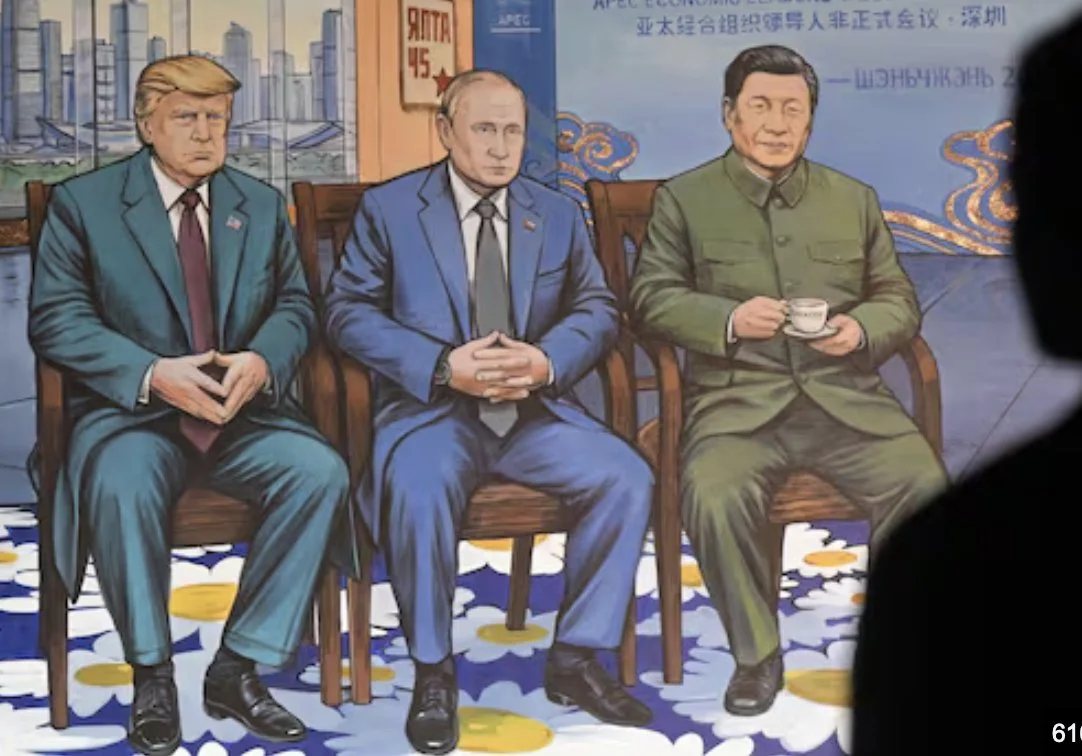
On view in Russia: “Shenzhen ‘26”
By ALEXEY SERGIENKO
LIKE MANY A PRESIDENT BEFORE HIM Donald Trump seemed to take refuge of a kind overseas. That shift of focus, his high-speed Asian journey of this week has been his variant of the pivot that has historically followed a massive public rebuke at home, in our midterm elections. That is, what Barack Obama colorfully called “a shellacking,” George W Bush “a thumping,” and what before them Bill Clinton (perhaps even more eloquently) called getting “the living daylights beat out of us."
I’m still searching for Trump’s eloquent assessment of his dramatic loss of both houses of Congress. So far he hasn’t been that clear.
But in the foreign context, Trump can maybe derive solace from looking, in all those colorful ceremonies everywhere he lands, as if he’s authoritative – actually, he’d probably prefer the term majestic. Especially if he could hear it in relation to the trilateral, said-to-be historic and unprecedented, meeting with China’s and Russia’s leaders.
Like so much with Trump, there’s a very strong emphasis on looking impressive. And even well ahead of the summit to be held in Shenzhen, China, he got a friendly little boost from a visual artist based in the jurisdiction, or domain, or fiefdom lorded over by Vladimir Putin, one of Trump’s role-models in autocracy.
In St Petersburg, the local artist Alexey Sergienko unveiled his painting (above left) titled Shenzhen ‘26 that depicted Trump, Putin and Chinese President Xi Jinping sitting together in a row, predicting their appearance together on the sidelines of the upcoming Asia-Pacific Economic Cooperation meeting (APEC). The painter posed the three men in a deliberate evoking of those classic photographs from 1945’s Yalta Conference, where the leaders Roosevelt, Stalin and Churchill divided up territories for the world after World War Two.
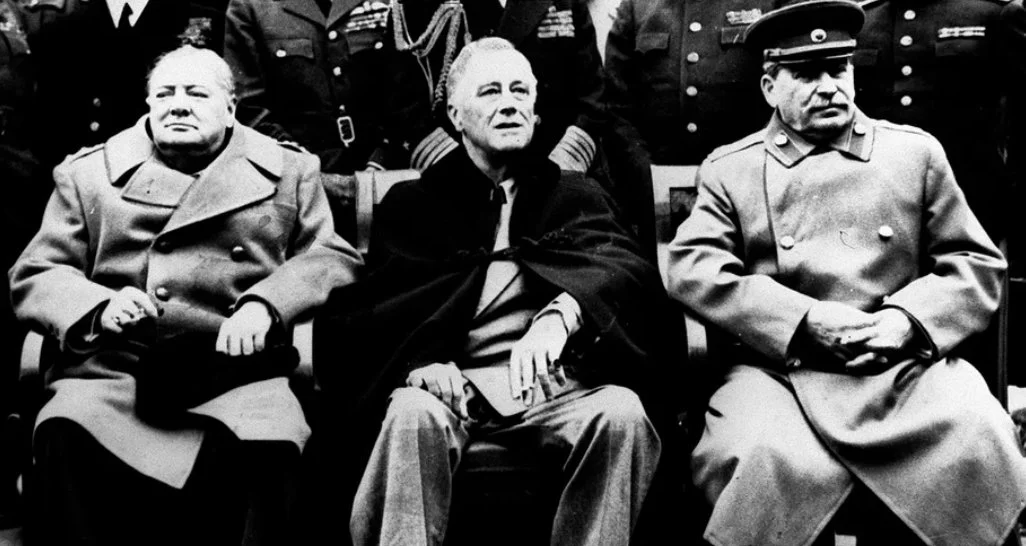
Yalta ‘45 - Churchill, Roosevelt, Stalin
Somebody I heard amid the jumbled chatter of commentators said, using a familiar cliché, that the triumvirate picture was “worth a thousand words.” (It’s a hoary old cliché dating back, by the way, to America’s early twentieth century advertising industry). I’m not naming the speaker who voiced it, because my possibly overreacting response was to find it blithely stupid. The picture was - obviously - immeasurably less informative than some careful words of analytical thought would be.
There were eventually too, of course, moving images of the actual event, in a seemingly ceaseless flow of repeating videoclips. And they all served, I’d say, to remind us that the whole shebang was primarily for show. To adapt a Trumpian phrase, one big beautiful photo-opp, in other words.
JOURNALISM FACES ITS FAIRLY COMMON CHALLENGE when international gatherings of leaders take place. Just what of substance is really going on? What is actually agreed, and what sidelined? What new directions will inter-government relations now take? All these questions are challenging … and I’m afraid to say this week they earned few convincing answers.
With this particular jaunt of the American president, it was striking how much was made clear to journalists by US government officials — anonymously, of course, “on deep background,” in the rather silly jargon — to lay out what issues would not be addressed by the leaders, or “principals” (as staffers feel obliged to label their top national representative).
There was, for instance, the not-so-small matter (and highly relevant you’d think) of the Nvidia company’s high-powered computer chips finding their way into Chinese hands. Plus alongside that, the forced resignation from that firm of its founder (and so recognizably an influential Trump confidant), Jensen Huang, once his departure was occasioned by extra-marital affairs, one with a woman suspected by US intelligence agencies of being a Chinese spy.
After the company’s spectacular stock-market collapse, there came this editorial assessment. “The most expensive extramarital affair in history,” said The Economist magazine, which I imagine must have special expertise in that area.
And then came a late-in the-decision by the Trump Administration to harden its export controls against Chinese access (often via Southeast Asia) to Nvidia’s advanced chips – all to be seen within the overall American effort to maintain our current Artificial Intelligence lead over China. The new controls did little to ease or smooth the path of diplomacy. In fact the immediate official Chinese response was to condemn the American measures as “a textbook case of economic coercion … that disrupts the stability of global industrial and supply chains.”
TRUMP’S REBELLIOUS ELECTORATE, though I doubt he gave them much thought, couldn’t fail to be further disturbed – as he flew comfortably away from them – the string of big technology outages we’ve been seeing. I mean, from air traffic - with last weekend’s Great ‘Groundstop’ nationally - to JP Morgan Chase bank accounts and even Microsoft’s own operating systems with 430 million users, plus Apple’s services, too … not to mention (because it doesn’t like being mentioned) a highly classified network of the National Security Agency.
The outages highlighted dramatically our increasing dependency on digital communications - and what can happen when they fail. But popular concern about A.I. and all its attendant uncertainties … even its alleged threat to humankind’s very existence … plus the already-underway pandemic of its required data centers being built everywhere, was not going to preoccupy Messrs Trump, Putin or Xi.
Other things not to be discussed when the global leaders met included (according to all the confidential pre-briefings) the outright war being conducted by one of those leaders against a neighboring country. Although he’s tried to keep descriptions of it downgraded to merely his own initial labeling of “a special military operation.” That’s of course Putin’s nearly five years of war now being fought on Ukrainian soil. This topic was very firmly excluded from all the early agenda outlines.
That was despite Trump himself saying, in one of those frequent comments yelled-out over engine-noise on the White House South Lawn helipad - that “We’ll talk about my favorite subject, Ukraine.” Who knew, huh? Favorite subject.
Then he went on to make the prediction that “Ukraine’s losing Ukraine.” He predictably enough didn’t spell out if he meant that such a loss would happen in the war, or in the big-power discussions. Oh, and he couldn’t have known that his comments would be followed hard by Ukraine’s armed forces successfully collapsing the vital Kerch bridge that connects Russia with the Crimea region that Russia illegitimately annexed.
Trump’s own war (against Iran, stumbling on as it does in its own haphazard way) – was something he wanted to find help in ending, but no-one else realistically expected that to happen in Shenzhen. And the status of nuclear non-proliferation issues was to remain unclear, with Trump supposedly wanting to discuss it, and Xi deeply leery about any suggestion of his weapon stockpiles being limited. Putin inevitably so, too, ever since the previous Russian-American nuclear arms treaty expired – with little effort to revive it – last February.
A HELPFUL REGIONAL SOURCE THIS WEEK for unpicking the meaning or meanings of the trilateral discussions has been the long-standing and once reliable South China Morning Post, though its ownership nowadays by China’s trading mega-corporation Alibaba must give us some pause. What the Post can be reliable for now is often relaying the thoughts of the ruling Chinese Communist Party. This week the paper quoted a strategic security expert from Tsinghua University, Professor Sun Chenghao saying that Trump (much more than Xi, we can assume) may well “have stronger momentum to seek diplomatic advances” following his domestic defeat in the midterms.
All in all, we can safely conclude that one parallel did prove absolutely correct between Shenzhen 2026 and Yalta 1945. Maybe it applies to all such top-level summits. It was a meeting of powers determining the fate of other smaller nations, while totally excluding those nations from the decision-making.
NOTE - The next week or two calls for some silence on my part. In keeping with our international mission, we’re moving The Media Beat’s operating base to the Republic of Ireland. We’ll resume, from there, in a couple of weeks.