
SCOTUS: Battles of Last Resort
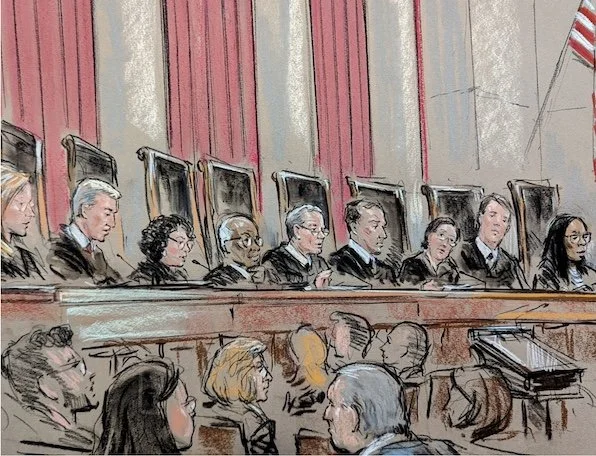
“The Supremes” - by court artist William Hennessy
OUR AMERICAN NEWS-MEDIA ARE FULL OF COURT-CASES nowadays, since the courts are evidently the resort most turned to by those people unhappy with the direction the current Administration is taking their country.
It’s a sharp end, you might say, of the broad disapproval of Donald Trump that Americans are expressing to pollsters. That amounts to a negative approval rating overall, says The Economist magazine in its poll of polls, that has slumped dramatically to minus-20 percent. Something that ABC News has archly described as the deepest disapproval of a President since 80 years ago, meaning 1945 when such polling first started. It’s Trump’s war on Iran that’s now mainly to blame, of course – the war itself and the rocketing gas prices that have been unleashed. But detailed breakdowns of the polls, mostly of people’s reasons for their views, show that a wider spread of discontents is additionally contributing to the Trump slump.
The pursuit via legal avenues for some degree of correction for Trumpian excesses is inevitably turning out be a long one – even when, or perhaps especially when, the first courts to hear a complaint will so often find in favor of the complainant, and against the Trump Administration. The government then of course almost always appeals.
In lower and then higher courts, the cases where the Administration is being challenged are unfolding across the entire nation, and are growing in number. A recent (February) edition of The Media Beat reported the calculation that they then totaled 650 lawsuits - and now the figure has climbed to well over 700. It’s a remarkable measure of the extent to which a government can be sued by its own citizens. One more judgement got added to the list only this week, when a federal judge ordered a halt to his development project for the White House’s East Wing, to make a grand ballroom.
Some of the cases will be fought as far as our topmost court, SCOTUS, that unappealing abbreviation for the Supreme Court Of The United States. And this week that court brought to the fore two particular cases that center upon vital matters of individual human rights. Two cases that appear to have very little in common – except, that is, both have derived their momentum from that central matter of popular discontent with government policy.
Wednesday this week was an Oral Arguments day, that rare day in Supreme Court proceedings on which Justice can genuinely be said to not only be done — but also, importantly, seen to be done. Ah, strike that. It’s not so much seen to be done, as it’s at least heard being done – heard by the general public, I mean.
It’s naturally a broadcast journalist’s delight – because on these special days there is audio. There is often drama – though exactly who might be speaking at any given dramatic moment has to be explained by a network reporter making his or her brief intrusion into the onward flow of our audio-feed, that often consists of Justices revealingly cross-examining the attorneys who appear before them.
THE CASE BEING ORALLY ARGUED was that of Birthright Citizenship – that especially American principle, and beloved by many Americans, until at least our present period of extraordinary unAmerican mean-mindedness and resentment. The Supreme Court hasn’t tackled this issue head-on since 1898, when it decided an immigrant Chinese family’s son could legally be considered an American citizen, simply because he was born in California, even though his parents were not citizens. It solidified, in other words, the idea that birth on U.S. soil is a primary determinant of citizenship.
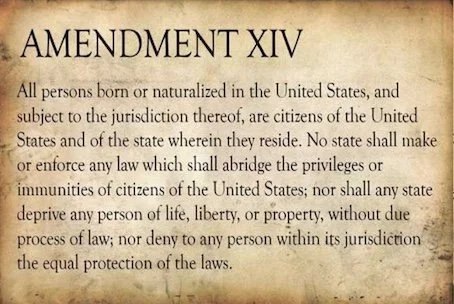
The prime movers in the argument against that right of citizenship by birth, which was created by the 14th Amendment to the Constitution (aboveright) after the Civil War, in 1868, have recently been Trump followers who’ve made much ballyhoo about ‘Birth Tourism’ – the practice of visitors coming here and bearing children. There are probably about 33,000 such cases in a given year – I’m not sure that this counts as a national emergency in a country of three-hundred-and-fifty million people. But there we are … it’s clearly an issue for the angry and aggrieved movement..
Trump himself intervened in the process (no surprise there, I suppose). Not in court, but on social media of course, he presented this angle, claiming that the people at fault were:
“Rich people from China, and the rest of the World, who want their children, and hundreds of thousands more, FOR PAY, to ridiculously become citizens of the United States of America.”
I may be naïve, or overindulgent of people like myself who have eagerly opted for the US as a home instead of our country of origin, but it seems to me that a different kind of “patriot” (to use that favored MAGA word) could take a position saying “As a patriot, I am so proud of my country … that it attracts outsiders to come here and start families.” I know: way too generous for our current times, for sure.
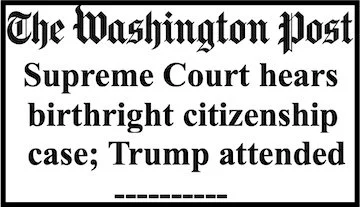
WaPo: April 1st, 2026
Just for good measure, at hs social site Trump added, in an odd almost poetic sentence-inversion: “Dumb Judges and Justices will not a great Country make!” And, on the morning of that oral arguments day he made another move unprecedented for a sitting president -- he turned up personally in the high court, and took a seat in the public gallery. He had several times during the past fourteen months threatened such a (presumably menacing) tactic (during the nation’s extended jitters over his trade tariffs, especially) but he had never actually shown up, until now.
He watched (for a while) as his Solicitor General argued for his plan to severely limit a citizenship right that has endured for over a hundred and fifty years. The Supremes, most of them anyway, seemed skeptical of the government’s case. That specialized band, the Supreme Court reporters swooped hungrily on the Chief Justice, John Roberts’ remark that the Trump side was relying on "very quirky" arguments. And the reporters sensed the prevailing wind might be blowing against the government, given complaints from Justice Neil Gorsuch, himself a Trump appointee to the bench, that the Solicitor General was citing outdated, even “Roman sources” in support of its case – plus the clear critique from Justice Elena Kagan, who said bluntly: "You're using some pretty obscure sources.”
SOMETIMES THE SUPREME COURT WILL DELIVER its decisions without waiting until the usual, public end of their term, in June.
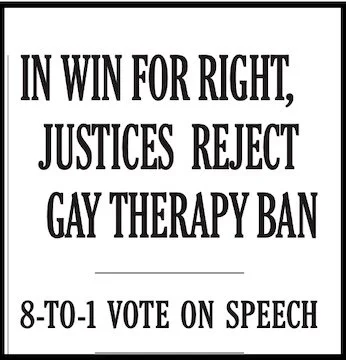
New York Times: March 31st, 2026
For instance, 24 hours before the Birthright Citizenship hearing, Tuesday of this week was an opinion day -- that colorful time enjoyed by Supreme-watchers for among other things, the arrival of “The Boxes,” those actual cardboard boxes in a discreet, pale-blue shade that contain in paper form multiple copies of the bench’s overall judgment – and, where it applies, any written dissents by members of the bench.
The landmark decision handed down this week was to decide in favor of a Christian therapeutic counselor in Colorado who opposed that state’s 2019 law protecting young gay people, or youngsters transitioning to another gender, from undergoing the controversial, so-called “conversion therapy,” which has been condemned by medical authorities as often dangerously harmful. The Court accepted the Christian counselor’s argument that it was a free speech issue. And though the original case had been initiated at state level, there can be little doubt that, at the federal level, it became a national struggle between the MAGA movement’s gender-based bigotry on the one hand, and on the other LGBQT+ rights, as pursued so spiritedly over the past few decades.
What seemed piquant, though, was that invocation of free speech, which appeared to be crucial in shrinking the Court’s usual liberal minority of three Justices to just a lone, but vociferous single Justice, Katanji Brown Jackson (below left). She took up her right, which is rarely exercised, to read aloud her solitary dissent – saying, in her perhaps most incisive criticism, that the majority decision will open:
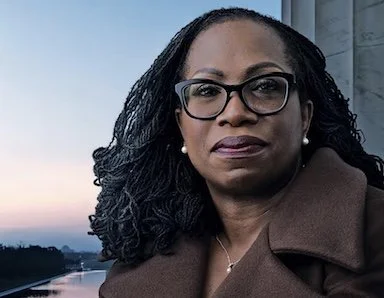
Supreme Justice Jackson
“a dangerous can of worms” [it] “threatens to impair States’ ability to regulate the provision of medical care in any respect” … [And pushes the Constitution] “into uncharted territory in an utterly irrational fashion” and “risks grave harm to Americans’ health and wellbeing.”
It’s been estimated that only one percent of all cases that start out in America’s lower courts will end up being heard by “The Supremes.” And while every one may not comprise actions directly against the Trump Administration, we can be sure that a good proportion of them between now and 2028 will be pitting the Trumpian world-view against its determined opponents.
One lower court decision this week has resounded rather close to home for me. It was Federal Judge Randolph Moss, in the District of Columbia, ruling that Trump’s order last year to end federal funding for public broadcasters PBS and NPR is unconstitutional – on grounds of the First Amendment’s guarantee of free speech. The White House has of course talked of appealing … so I wouldn’t be surprised if this case becomes one of those that get propelled all the way up the system to SCOTUS.