
Dissecting that ‘Special Relationship’
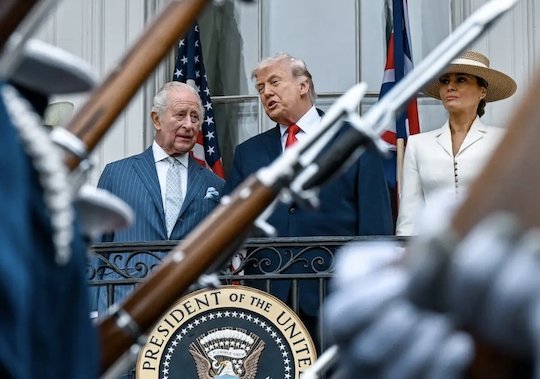
KING, TRUMP & Mrs TRUMP with march-past of muskets and bayonets
HOW SPECIAL IS THE “SPECIAL RELATIONSHIP,” REALLY – that supposedly unique alliance between the Unted States and the United Kingdom? Has it ever been as special as claimed?
The UK’s King and Queen visiting the US this week highlighted these questions. And for me the positively weird excitement over the royal trip – frothing at the mouth almost – that the media displayed, especially broadcast media of both countries, calls for some realistic and calm assessment. I will, though, confess to some obvious lack of objectivity on my own part — but no partisanship, I will insist — because I happen to be a citizen of both nations.
One thing to get out of the way immediately … is that the ostensible purpose of the visit was to celebrate the 250th anniversary of the USA’s very existence. Maybe you’ve learned this year, as I have, to call it the Semi-Quincentennial of American independence. That independence was the result, of course, of a war of rebellion waged by the 13 original colonies against the great colonial power, Britain and its then-King.
And of course those rebellious colonies grew to eventually be a single Colossus to bestride the whole world (to take words from England’s greatest dramatist). While Britain, for its part, eventually shrank in power and became in the twentieth century what the former US Secretary of State and John F Kennedy’s trusted adviser, Dean Acheson damningly described as a country that had “lost an empire and not yet found a role”. Many people internationally, and at home in the UK, will say that is still true.
So the British, while happy enough to celebrate the long-lasting phenomenon of American independence, had in mind a real purpose, too, for this week’s royal state visit – that is, the purpose of cementing relations between the two countries -- somewhat obsequiously on the part of Britain, it has to be said.
The plan had been in the works ever since or even before the September 2025 trip to the UK by Donald Trump, which included a lavish banquet at Windsor Castle and a ride around its grounds in a procession of gilded horse-drawn carriages. It was very obvious then, if it wasn’t already, that the American President could be as gaga about the royals as the American press, and much of the American public, can be. And sure enough this week Trump has been quoted as calling His Majesty a “fantastic person” and describing the royal couple as “incredible people.”
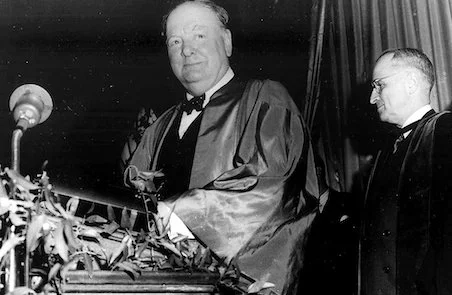
CHURCHILL & TRUMAN, 1946
Having to cement that “special relationship” has been a priority for the Brits ever since the phrase was first adopted, by Winston Churchill – first in a 1944 private note to a loyal lieutenant in government, Richard Law, and then voiced much more publicly in the wartime Prime Minister’s famous speech in Fulton, Missouri in 1946, after the Second World War had been won – largely through America having joined in the effort. With that speech, not only did Churchill thank the US for helping to win the peace, but he also voiced another fateful coinage – the words “Iron Curtain,” for the division between former allies, the Soviet Union, and our western world.
By the way, as a condition for agreeing to give that speech, at a college in Fulton, which by no coincidence was President Harry Truman’s hometown, he insisted that the President accompany him there, and listen to the speech. Churchill was not at the time a coequal head-of-government with Truman, he was merely a regular British citizen, having been voted out of office after the war – since British troops returning from the battle for freedom did not favor his brand of conservatism, war-leader and hero-figure though he might have appeared to be. To some degree he now had to earn his own way in the world, and was paid by the Fulton college $10,000 (roughly 150,000 in today’s money) for his rhetorical work of shoring up the transatlantic alliance.
IN FACT THE ONUS OF CEMENTING BILATERAL RELATIONS has always heavily fallen upon the UK side of the pairing. US attitudes have grown to be decidedly less enthusiastic, and long before the offensive high-handedness of Trump. During the Bill Clinton presidency in the 1990’s, I remember being told something quite bluntly by one of his senior foreign policy advisers, though it was coated in an attempt (utterly typical for Clintonites during that time) at some studied politeness. The adviser said: “The Special Relationship? It’s special for you, we can see that. But for us? Not so special, quite honestly.”
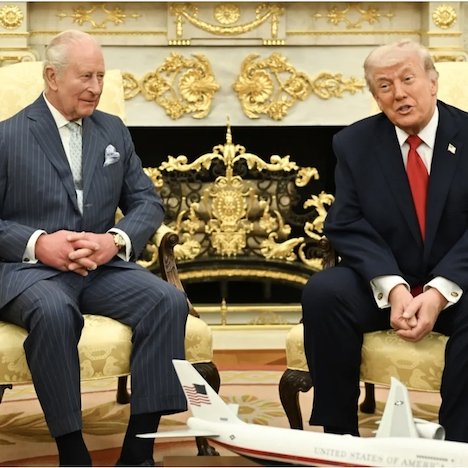
KING & PRESIDENT in White House
The Buckingham Palace team obviously worked hard, following most of the advice supplied by Prime Minister Keir Starmer and his experts in Downing Street. They hit on a central notion for the rhetorical theme throughout the visit (and especially at that most public occasion - the King’s speech to both Houses of Congress) and they thoroughly briefed both nations’ journalists with it. The theme was to be “Reconciliation and Renewal.” That in itself indicates a worried recognition that there’s been a definite rift (and maybe the arrangement has actually expired) – if both reconciliation and renewal are required.
The BBC’s commentators, I noted, repeatedly voiced the old saw that the King’s role as a “constitutional” monarch is to “fly above the level of politics” – it was said time and time again. What utter nonsense. Few things could be more political than stressing, in the country whose leader had openly split with the NATO alliance that:
“In the immediate aftermath of 9/11, when NATO invoked Article 5 for the first time [that’s the treaty article saying an attack on one country is an attack on us all] … we answered the call together, as our people have done so for more than a century, shoulder to shoulder.”
I was surprised to see the clever analysts of Politico write that this was a “coded message”. Pretty darned simple code, if you ask me.
Just as simple to read was Charles’s very evident counterpoint to Trump’s incessant criticisms over recent months of Ukraine and its president, Volodymyr Zelenskyy. The King told Congress that the response to 9/11 should also inspire America’s approach to Russia’s continuing, unacceptable invasion. “Today,” he said, “that same, unyielding resolve is needed for the defense of Ukraine and her most courageous people”
KING in Congress, plus VEEP & SPEAKER
The royal speechwriters had, it seems, studied Trumpian prose closely. Imitation is sometimes the sincerest form of flattery. The King read the line very carefully that described the transatlantic relationship as “one of the most consequential alliances in human history.” The little, moderating phrase “one of” seemed like a mere obligatory nod toward England’s reputed, and not always deserved, reputation for being tactful.
It was all in all, without doubt a political speech. But whether it will have any effect politically … that is a very different matter. The visit was, after all, an example of what diplomats call (and increasingly journalists also call, especially during this trip) the “soft power” which is all that’s available to nations (like the UK?) who are somewhat lacking in hard power. Speaking in Washington’s arenas of very obviously hard power– Congress and the White House - Charles’s elegant wording came off finally as very soft indeed.
Britain’s former Ambassador to Nato, Peter Ricketts blew some refreshingly cool air into the American network NPR’s coverage when he frankly told an interviewer: “No one’s going to pretend that [the trip] will change the underlying difficulties in our relations.”
Nonetheless, with the trip over, Palace courtiers will doubtless be consigning the visit into their ledger of living history as a venture in which the King was bold.
I on the other hand will beg to differ, by citing another issue that was deliberately sidelined and completely avoided during the tour. Really “bold” would have been for the Royals to meet (as was asked for, loudly and clearly) with survivors of the Jeffrey Epstein sex-abuse scandal. Advisers may want to treat the crimes involved as a mere footnote to great events … but the truth is whether the White House and the Palace like it or not, the whole sorry and horrific mess has so clearly and dangerously enveloped both America’s wannabee-king, and the actual King’s beleaguered brother.
AT THE RISK OF SOUNDING AS GAGA MYSELF as much of the American media have been, I want to end by highlighting a small detail of the royal trip not greatly reported nationally, though it had some resonance in my hometown, New York City. Our main Public Library (for which I once used to work, by the way) held an event to honor the immortal British children’s author A.A. Milne.
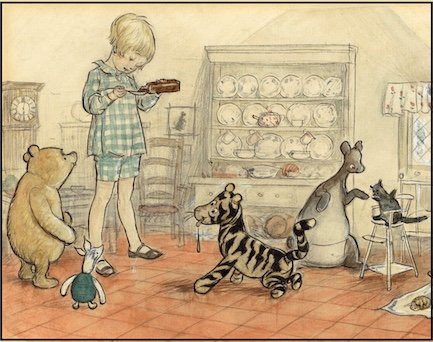
POOH (far left) & friends - baby ROO in high chair at far right — Drawn by E.H. Shepard
My sister and I, part of the same generation as Charles and Camilla, grew up in Britain with Winnie-the-Pooh and Milne’s other cast of characters who brought to life nursery toy animals like Piglet and Eeyore, the glum donkey.
By a process that I hope doesn’t smack too much of appropriation by a culturally imperialistic America, the actual little stuffed animals who inspired the stories were of course originally owned by the Milne family and played with by young Christopher Robin Milne … but the group is now possessed by our city’s Library. They’re on permanent display there. But, there’s one character missing. That’s Roo - the junior member of a pair, mother and son, Kanga and Roo, who together of course must have hailed from Australia.
According to the library, Roo went missing way back in the 1930s, reportedly in an English orchard. Well, the loss has been remedied. Queen Camilla brought in her baggage on the Royal Flight a replacement model, created by the original company in Shropshire called Merrythought which had once made all the historic stuffed toys, basing them on E.H. Shepard’s classic illustrative sketches.
Camilla’s ceremonial gifting of baby Roo to the library was described to reporters by one impish British official as an example of “soft(-toy) power.”