Omitted from Observance Of Our 250th
ETHEL PAYNE’s HAT
FOR THE NATIONAL HOLIDAY IN THIS YEAR that marks 250 years since our country’s founding, one of the Smithsonian Institution’s twenty-one museums, the National Museum of American History has mounted a powerful collection of 250 objects of historical significance. They include Thomas Jefferson’s portable desk, at which he reputedly began drafting the Declaration of Independence … and (from this century) an ironworker’s hard-hat to emblemize the thousands of volunteers who worked on the crushed ruins of New York’s Twin Towers after the 9/11 attacks.
But there is - for me - a glaring omission from this patriotic exhibition along the National Mall. It’s to be found, instead, in another part of the Smithsonian system (more of that later) — and it consists of another, very different kind of hat.
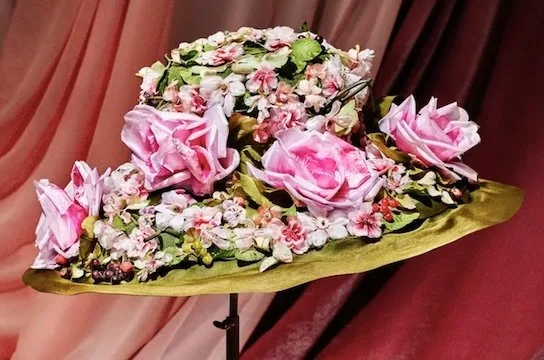
It is broad-brimmed in velvet of a pistachio color, crowned with pink and white silk flowers, plus even some grapes made of glass. The hat belonged to, and was a striking kind of trademark for Ethel Payne, otherwise known for decades as “The First Lady of the Black Press.” She initially worked for the Chicago Defender newspaper in the 1950s, and she went on to become the first African-American woman inside the White House press corps … the first Black American woman to be a commentator on national TV … and the first Black American woman to become an international roving correspondent.
Ms Payne died at the age of 79 in 1991, the year that I moved my home base from Britain to America, but I was already well aware of her legendary reputation. She had been, in 1955, one of the very few Americans who attended - either as delegates or observing journalists - the Africa Asia Conference held in Bandung, Indonesia. This was the world’s first-ever international summit held without the domineering presence of Western colonial governments, and it has since been credited as first giving rise to the idea of the Third World.
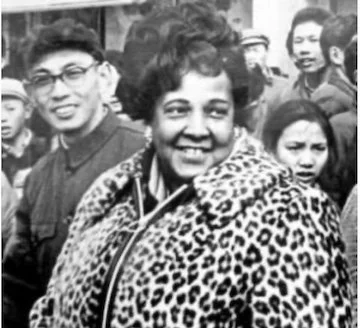
ETHEL PAYNE in Shanghai, 1973
That’s what we called it then, rather loosely -- the Third World, as opposed to the period’s predominant two-sided power rivalry between the US and the Soviets. We nowadays have come to call it the “Global South.” I’d say numeric looseness has been replaced by geographic looseness. After all, Bandung, Indonesia is — indeed all of Asia is — situated not in the South but entirely in the Northern hemisphere. But that’s merely my pedantry.
When I started, in the 1980s, to concentrate on that so-called Third World in my coverage for the UK’s newly-created Channel 4 Television, I shared airtime with a pioneering, multiracial and multicultural news-team. The recurring TV program that resulted was called The Bandung File. For all of us concerned with the fate of developing nations, Bandung was a very redolent reference point.
The visible journalistic credentials required by Ms Payne for the Bandung summit amounted to a lapel pin — which has become a companion piece to the attention-grabbing hat. They’re both to be found exhibited at a very much smaller Smithsonian establishment, compared with the National Museum. That would be the Anacostia Community Museum, six miles away across the Frederick Douglass Bridge, in Washington’s historically black district of the same name, Anacostia.
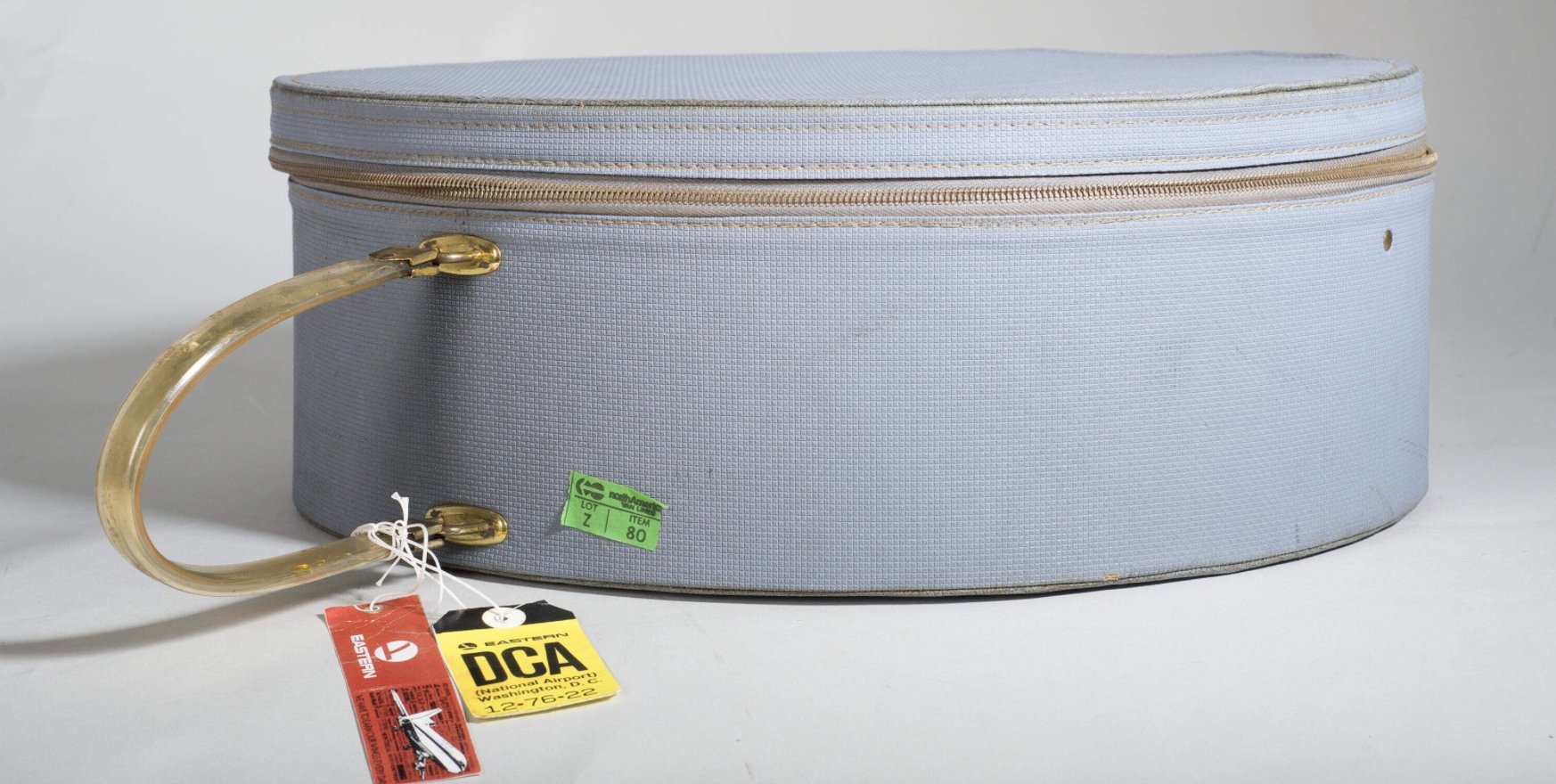
But about that hat. It’s currently perched on a display-stand not far from its matching round hatbox, which is still tagged with carry-on labels from the various airlines that flew Ms Payne around the world. The curator at Anacostia, Jennifer Sieck has evoked the hat’s visual impact this way:
“Payne really attended to her attire. It is a profusion of flowers … roses and violets - on a pistachio-colored hat that she wore with panache.”
The hat is very much in the tradition of what their wearers and admirers call “fancy hats,” “church hats” or even sometimes “Crowns” -- and they’ve long been a common and colorful feature at Sunday morning worship.
BUT THERE WAS MORE INVOLVED than style and cultural tradition – there was something decidedly practical and indeed professional about Ms Payne’s hat. As Curator Sieck has also said, the headgear “identified her when she was a reporter in a room with mostly male reporters. They had their hats off indoors, as was the custom — and she had hers on.”
The value of standing out from the crowd, especially in press conferences, is keenly appreciated in our trade. My own techniques have included, at many tech and media gatherings especially, the wearing of a brilliant white blazer, even in winter months. I never encountered another one - dull gray and navy clothing seemed to abound. And, when wearing bright white, I was almost always called on to toss a question at whatever spokeperson was addressing us from the podium.
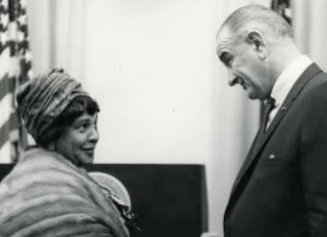
ETHEL PAYNE & President JOHNSON
But just in case you think I’m comparing myself to Ms Payne, let me stress how much we differ. I was only ever on close terms with very few Presidents or Prime Ministers, let was alone was ever given a gift by any of them. She on the other hand interacted with seven US Presidents in succession, Eisenhower, Kennedy, Johnson, Nixon, Ford, Carter, Reagan. And one of them, Lyndon Baines Johnson gave her one of those prized presidential pens – in this case, one with which he signed into law the momentous Civil Rights Act of 1964.
I’m glad to report that this pen is also on display at the Anacostia Museum. LBJ’s clear and respectful recognition of her was a big change from Dwight D Eisenhower, whom Ms Payne gained some notoriety for harrying, especially as she doggedly pursued questions about racial desegregation. That president got to the point of refusing to take any of her questions.
Her dedication to pursuing civil rights issues was deep-rooted. It dated back to the 1940s when she joined forces with A. Philip Randolph, the labor organizer who led the Brotherhood of Sleeping Car Porters. Herself the daughter of a Pullman porter, she worked with Randolph to organize the March on Washington that was planned for May 1941. The mere threat of a predicted 100,000 protestors converging on the nation’s capital frightened Franklin D Roosevelt into issuing his famous Executive Order number 8802, which prohibited racial discrimination in the federal government and its defense contractors. It was an early milestone in the progress toward ending institutionalized racism.
The fire kindled by such national campaigning was to remain, in Ms Payne’s journalism, a steady flame illuminating her community’s insistent demands for human rights. She was always a challenging presence among journalists. She famously said:
"I stick to my firm, unshakeable belief that the Black press is an advocacy press, and that I, as a part of that press, cannot afford the luxury of being unbiased."
And her anti-racist commitment formed an arc from the US right across the eventually more than thirty different countries on which she reported.
In the year of her death even, 1991, she was among the first correspondents to interview South Africa’s Nelson Mandela when he finally emerged from 27 years in a white nationalists’ prison. Once again, she was way ahead of other journalists, including me. It took me another 3 years before I could interview Mandela, just before he became South Africa’s first black president,
Ethel Payne’s preeminence in the struggle against white supremacy and injustice certainly deserves to be celebrated at this time of reflection on America’s history. I’m glad that four of her evocative possessions - hat, hatbox, pen and pin - are being highlighted in Anacostia’s museum; but I can’t help thinking that it’s the Smithsonian’s national exhibition that should be featuring her — not least that triumphant, flowered hat.