
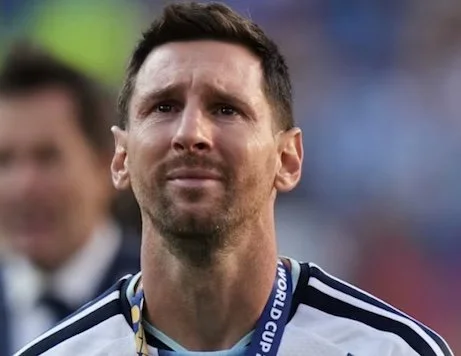
Captain LIONEL MESSI in tears after losing the World Cup
I’M BACK NOW, AND READY to reflect on a journey I just took to the land of what-might-have-been.
Yes, Argentina, the home of the World Cup’s previously reigning male champions, who so dramatically defended their top position through a series of nail-biting recoveries from what each time looked dangerously like losing, but they turned into winning again and again … only to encounter agonizingly, in the Final match earlier this week, the disaster of complete defeat.
It matters, oh how it matters to that football-crazy nation (and yes, I mean football, real football – not what north Americans try to sideline with the name “soccer,” a label that can still often carry a condescending tone when applied in the US). The game can matter possibly more than anything else in life to Argentinians. And I know full well that treating the so-called “Beautiful Game” as vital to the soul of a nation is not limited to that one Latin American country. Another country, my own country of origin, Scotland, exerted a huge historic influence on Argentina’s starting to play the game in the first place. More of that later … but for now I need only cite a famous Scottish football manager and his defining assertion on this general issue. I’m thinking of Bill Shankly - because in a memorable TV interview 25 years ago he offered some helpful perspective on the passions that the game can engender, in whatever nationality. He said, I quote in full:
“Some people believe football is a matter of life and death, I am very disappointed with that attitude. I can assure you it is much, much more important than that.”
That notion was certainly borne out in the streets of Buenos Aires. After the national team pulled off its winning goals against England in the semi-final — as often, scoring scarily late in the match — the citizenry went almost literally wild.
Crossing town after that match in a taxi was a death-defying journey: cars weaving about erratically, with the national blue and white flag streaming from their open windows, along with the passengers’ chants of joy, plus car-horns rhythmically honking out a claxon form of chants. Crowds poured out from bars and cafes also chanting of course; they filled the sidewalks to capacity and also spilled out dangerously onto the already traffic-filled roadways. A delirious pandemonium.
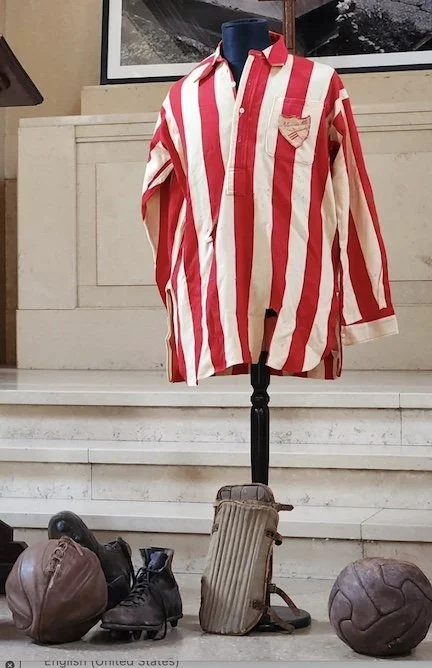
Museum Pieces: Late 19th Century Argentine football shirt, plus period balls, boots, and shin-pads
Then … came the devastating contrast only four days later – symptoms of a nation in mourning. Immediately after the Final ended with the Spaniards’ victory, there was a kind of angry denial of death on display: ugly brawling scenes between Argentinian players unwilling to accept defeat and their Spanish opposite numbers. To counter this, the national coach Lionel Scaloni urged his team toward calm:
"We are gracious in victory, and we must be so in defeat. We accept the loss. We gave our everything."
And as for the nation as a whole, beyond the players themselves … disappointment took many forms. Acceptance was expressed, first by a subdued silence followed then gradually by a very new chant from the crowds that filled the capital city’s central square. In unison, they proclaimed to their team: "¡Gracias, iguales!" – thank you, all the same.
THE COMPLEX MATTER OF PRIDE, especially hurt and offended pride, in Argentina’s national identity has been stirred (sometimes only latently, sometimes very obviously) through forty-four long years. Since, in fact, the Malvinas War of 1982, as Argentinians know it, when they were beaten by Britain on a very real field of armed battle, not just a sports stadium, and when actual blood and guts were spilled. Prime Minister Margaret Thatcher had ordered a colonial retaking of what Britain calls the Falkland Islands, in response to an Argentine attempt to seize them. (They lie a mere 300 miles off Argentina’s coast.)
Many Argentinians will not forget that war. At the end of the semi-final they won against England, some Argentinian players unfurled a banner with the slogan “The Malvinas are Argentinian.” And just ahead of that semifinal, the country’s vice-president, whose father fought in the war and was taken prisoner by the Brits, had made a point of declaring:
“It is not just another match … We are playing against usurping pirates.”
LEAVING ASIDE ALL THE DISTINCTIONS to be made between the entities of Britain, England and Scotland, I had a long discussion about the Scottish origins for Argentine football with the head of the Scottish-Argentine Association, Eduardo McCrae. He’s one of a perhaps surprising number of Argentinians who have a Scottish last name and a Spanish forename. In Mr. McCrae’s case, he prefers to go by a casual version of his forename – he’s Eddie McCrae, and it of course tilts him into sounding even more Scottish.
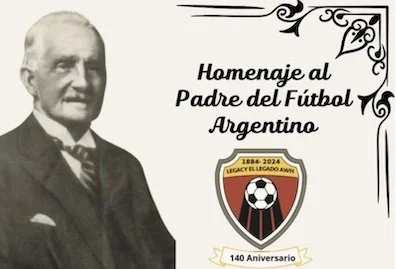
Tribute announcement: The ‘Father of Argentine Football’ - ALEXANDER WATSON HUTTON
There was a certain irony in where we sat and talked – directly opposite a Buenos Aires landmark that Eddie was not disposed to discuss. It’s a 250-feet-tall clocktower designed in 1916 with a mechanism made by the same clockmakers who constructed the Big Ben clock in London and it strikes each quarter-hour with the same chimes as in London. Maps and tour guides nowadays call it simply the Tower Monument (in Spanish, La Torre Monumental). Initially it was called La Torre de los Ingleses – but that changed in the 1980s with the Malvinas war and the country’s humiliating defeat at the hands of los Ingleses. Directly across the highway from the tower is a national war memorial, solemnly commemorating the Argentinians who died in that war.
Perhaps it’s fortunate that FIFA’s arcane way of grouping national teams in the early rounds of the championship ensured that Argentina never played against Scotland – that might have created, for at least one member of the then-champion squad, some ancestral uneasiness. That would be the energetic, frequent Argentinian goal-scorer who bears the name Alexis Mac Allister.
And yes indeed it was, as I indicated earlier, a Scottish immigrant, Alexander Watson Hutton who first established the Argentinian Football Association in 1893 – after introducing football into the curriculum of the country’s preeminent English-language high school. Hutton was born in the tenement buildings of Glasgow’s Gorbals district, was orphaned before reaching the age of four, and went on in adulthood to become a schoolteacher. In 1881 he answered a small ad in Edinburgh’s The Scotsman newspaper offering senior teaching work at what the ad called the “Scotch School” in Buenos “Ayres” (Ayres spelled then with a Y, below right). So it was that, now more than 130 years later, the Football Association’s president went on record saying:
“In Argentina, today’s hero is Lionel Messi, and previously it was Diego Maradona. But the real hero of Argentinian football is Alexander Watson Hutton, the Scotsman.”

‘The Scotsman’ small ad that brought Hutton to B.A.
THE SCOTTISH-ARGENTINE ASSOCIATION that Eddie McCrae leads has put into the Buenos Aires social calendar a significant annual ritual – this year’s will happen just three weeks from today, on August 11. It celebrates the arrival of a particularly sizeable contingent of Scots on that same day in 1825. Every year now, they re-enact in period Scottish costume, and with Scottish bagpipe musical accompaniment, the landing of those new arrivals, including Macdonalds, McNeills, Sinclairs, Buchanans and more, stepping onto shore on the banks of the River Plate.
It’s called simply El Día del Inmigrante Escocés – The Day of the Scottish Immigrant. It’s a striking example of a diaspora honoring themselves as immigrants in a nation of immigrants. As an immigrant myself to a more northerly part of the Americas, I’m reminded of those times, not so long ago, when the USA would take some comfort, pride indeed, in calling itself: “A Nation of Immigrants.” How sadly quaint, maybe naïve, that phrase can sound in today’s angry and fractured country.
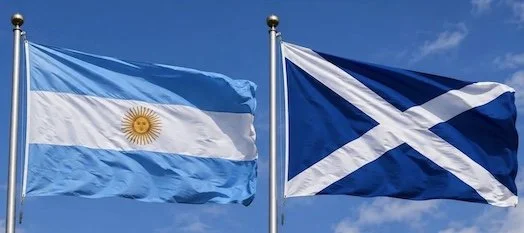
Argentine and Scottish flags flying for ‘El Día del Inmigrante Escocés’
Many realms across Argentine society have also owed much to Scottish immigrants. Among the first of many overseas physicians to arrive, in 1817, was Andrew Dick, a Scottish professor of medicine who went on to found Argentina’s own Academy of Medicine. Scots helped enormously in providing the rapidly developing nation’s infrastructure – notably the considerable railroad network, waterworks and sewage in the cities, and perhaps most evidently agriculture out in the vast countryside. Argentina’s world-famous beef industry owes its beginnings to the importation, circa 150 years ago, of Aberdeen Angus cattle, who have ever since fed well on the pampas grasslands, as nutritious as those of their native north-east Scotland.
But the industry of greatest interest to The Media Beat has to be journalism. This is a notable year for the nation’s leading English-language newspaper, the Buenos Aires Herald. It’s exactly 150 years since a Scot, yes of course a Scot, called William Cathcart founded the Herald in 1876, setting in motion a tradition of fine journalism, speaking truth to power.
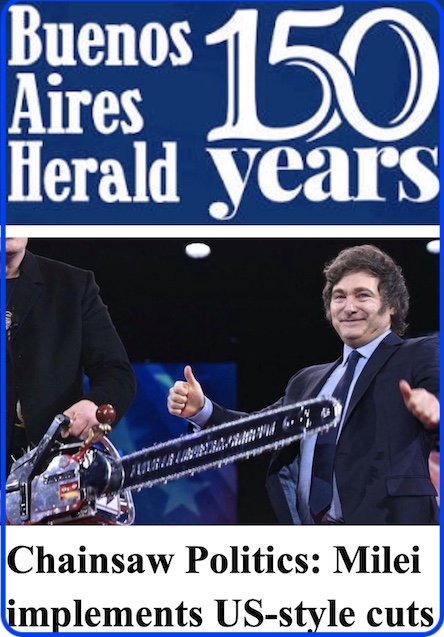
BA Herald reports on the President in its own 150th year
Perhaps most heroically, the paper’s incisive reporting exposed the atrocities committed during the baleful era of military dictatorship that the country endured in the 1970s and ‘80s. I last reported on its current work a year ago, and that work continues, as the paper regularly calls to public account the right-wing, self-proclaimed libertarian President Javier Milei. In the words of the paper’s current Editor-in-Chief Estafanía Pozzo, “for us, 150 years means preserving an editorial practice rooted in democratic values, one that refuses to bend when put to the test.”
PRESIDENT MILEI IN LARGE MEASURE OWES his continuing power to some enormous assistance from the Trump Administration – not least a massive loan of 20 billion US dollars – in the form of a currency swap. The bailout proved critical in averting a run on the fast-sinking Argentinian peso.
It was certainly consistent with Trump himself praising Milei for sharing the same political outlook as himself, while he welcomed the Argentinian to the White House. “He’s MAGA all the way,” said Trump. “He’s ‘Make Argentina Great Again!’” The U.S. Treasury’s financing seems to have worked, and functioned as some out-and-out electoral interference. One of Milei’s supporters, businessman Jorge Trucco, who’s reputedly been a mentor for the president during his journey into libertarian, laissez faire economics, told me:
“Those 20 billion dollars saved Argentina. Milei’s side was in danger of losing the mid-term elections for the National Congress [they’re due in October this year] - and now his people are set to win, and win big.
The president himself will not be facing the electorate again until October 2027.
One of the issues on which the Herald has persistently critiqued Milei is the way his swingeing cuts in public spending have hindered those vital efforts at reckoning with the country’s grim dictatorial past. Not least, there was the appalling theft of children, often new-born babies, who were stolen when the authorities of those repressive years imprisoned their parents – and tortured and often murdered them – the victims infamously becoming named the “disappeared” (Los Desaparecidos). Many of the stolen children were given to army or police officers to raise as their own — and only with the aid of some dramatic matching of DNA samples, have some of them (now numbering in their hundreds) been accurately identified and eventually as adults reunited with their real families. Often sadly, though, it’s to their grandparents they are reunited, since their mothers and fathers were killed by the former regime.
As the relatives, and human rights organizations – including the government’s own secretariat of human rights – try to continue the search for bodies of the disappeared, and for more stolen children, they are facing an administration (Milei’s since 2023) that is defunding the groups conducting the searches, while at the same time promoting a revisionist history of the dictatorship period.
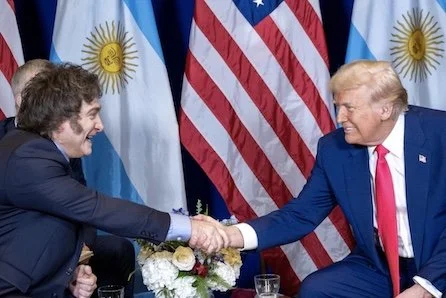
Dos Presidentes de MAGA
MILEI IS OPPOSING THE CONSENSUS that’s widely prevailed over the past four decades since the return of democracy that followed the dictatorship years. He and his supporters argue that left-wingers have overemphasized past state crimes, while ignoring violence conducted by leftist guerrilla groups. Milei’s own phrasing for it has been that the military dictatorship’s crimes were merely “excesses” that were bound to occur as part of a war conducted against “extreme leftists.” I also heard the label “communists” used by Milei’s fans in this context, just as it has recently been taken up, again and again, by Donald Trump in the US.
But the mothers and grandmothers of the disappeared are not to be dissuaded. Every Thursday they still march in the central square, the Plaza de Mayo. Nowadays their most frequent slogan has become "¡Milei, basura, vos sos la dictadura!" It doesn’t rhyme in English translation, but its meaning is clear: “Milei, trash, YOU are the dictatorship!”
While the mood of Argentina may now be somber and subdued after defeat for its beloved exponents of the nation’s pastime, we can nonetheless count on the journalists of its free press to actively carry on their mission. To cite Editor Pozzo again: “we’re doing journalism for an audience that needs information they can trust” — and, I would say, also for all of us, wherever we are, who want to understand what the paper carefully calls the “divergent points of view” that are now criss-crossing all of Argentinian society.